Posture correction exercises are simple moves that strengthen the muscles of your upper back, core and hips. The same moves stretch the tight muscles in your chest, neck and hips that pull you into a slouch. Together, they help your body hold a neutral spine, with your ears, shoulders and hips stacked in one line. The most common posture correction exercises are chin tucks, wall angels, doorway chest stretches, rows, glute bridges and planks. Most need no equipment, and you can do them at home in a few minutes. An Ohio State physical therapist suggests 3 sessions a week and 3 to 6 weeks before you expect to notice a difference.
Below: what good posture is, 10 exercises grouped by body area, a simple daily routine, how long it takes and when to see a doctor.
Key takeaways
- Posture correction exercises strengthen your upper back, core and hips and stretch tight chest, neck and hip muscles.
- Good posture stacks your ears, shoulders and hips in one line, but no single position is perfect, so change position often.
- Aim for about 3 exercise sessions a week with a rest day between, plus short movement breaks every day.
- Give a routine 3 to 6 weeks, and stop and see a doctor if you get numbness, tingling, weakness or worsening pain.
What is good posture?
Good posture is a position where your body stacks in a straight vertical line. Standing, that line runs through your earlobe, the tip of your shoulder and the side of your hip, then down through your knee and ankle. Seated, your ears, shoulders and hips still line up, with a slight hollow in your lower back.
Harvard Health lists the main signs of good posture:
- Your chin is parallel to the floor.
- Your shoulders and hips are even.
- Your spine is neutral, with no extra arch or slump.
- Your abdominal muscles are lightly braced.
- Your weight is spread evenly over both feet.
Good posture isn't one rigid pose. Hinge Health's physical therapists say there's no single perfect posture, and that "your next position is your best position". They suggest switching position after 20 to 30 minutes in one spot.
Muscles explain why posture drifts. Weak core muscles let you slump, tight hip muscles can pull your upper body forward, and tight chest muscles can pull your shoulders forward. Posture correction exercises target exactly those muscles.
Neck exercises for posture
Neck exercises for posture train your head to sit back over your shoulders instead of drifting forward. Move slowly and stay in a comfortable range for every exercise on this page. If a move feels too hard or causes pain, stop and ask a physical therapist.
1. Chin tuck
Sit tall and draw your chin straight back without tilting your head up or down. Hold for several seconds. Ohio State's version is done lying on your back: tuck your chin and gently sink the back of your head into the mat, then hold for 3 seconds and repeat 10 times. Our guide to chin tucks covers the technique and 5 variations.
2. Side neck stretch
Sit upright and look straight ahead. Hold your left shoulder down with your right hand, then slowly tilt your head to the right. Hold for 5 seconds and repeat 3 times on each side.
If your head sits well in front of your shoulders, our guide on how to fix forward head posture adds desk and phone habits.
Upper back and shoulder exercises
Upper back and shoulder exercises open a tight chest and strengthen the muscles that draw your shoulder blades back. These are the key posture exercises for rounded shoulders.
3. Wall angels
Stand with your back against a wall, arms at your sides and palms facing out. Slide your arms out and overhead while the backs of your hands stay on the wall. Hold for a few seconds, then lower slowly.
4. Doorway chest stretch
Stand in a doorway with your elbows bent to 90 degrees and your palms on the frame. Step one leg back and lean forward until you feel a stretch across your upper chest. Hold for a few seconds, then switch legs.
5. Band row
Anchor the middle of a resistance band to a doorknob and hold one end in each hand. Pull the band back, keeping your elbows close to your sides, and squeeze your shoulder blades together. No band? Hold your fists in front of you at shoulder height, draw your elbows back and squeeze your shoulder blades for 10 seconds.
6. Superman
Lie on your stomach with your arms stretched overhead and a small rolled towel under your forehead. Lift your right arm and left leg 1 to 2 inches, then switch sides. Hold each lift for 3 seconds and do 10 repetitions.
For gentle stretches that loosen the same area, see our upper back stretches. If your shoulders also roll forward at night, here's how to sleep to help rounded shoulders.
Core and hip exercises
Core and hip exercises build the "central link" between your upper and lower body that keeps you from slumping.
7. Glute bridge
Lie on your back with your knees bent and your feet flat, about hip-width apart. Gently tighten your stomach muscles, then lift your hips until they line up with your knees and shoulders. Avoid tilting your hips. Hold for 3 seconds and repeat 10 times.
8. Bird dog
Start on your hands and knees and tighten your stomach muscles while you keep breathing. Raise one arm straight out in front of you and hold for about 6 seconds, then switch arms. Repeat 8 to 12 times with each arm. Once that feels steady, lift one leg behind you instead, then the opposite arm and leg together. Over time, work up to 10 to 30 seconds per hold.
9. Plank
Start on your hands and knees with your hands under your shoulders. Step your legs back so your body forms a straight line from head to heels, and squeeze your core and glutes. Don't let your hips dip or rise. Healthline suggests holding a high plank for up to 1 minute. Drop onto your forearms if that's too hard.
10. Hip flexor stretch
Stand with your feet hip-width apart and step one foot forward. Bend your front knee and push your back hip forward, keeping your chest upright, until you feel a stretch at the front of the hip. Hold, step back and switch sides.
A simple daily posture routine
A simple daily posture routine combines short movement breaks every day with a fuller exercise session about 3 times a week. An Ohio State physical therapist suggests 3 sessions a week with a rest day in between.
| When | What to do |
| Every 10 to 30 minutes at a desk | Check your posture, stand up or change position. Add 2 or 3 chin tucks. |
| Every day | Chin tucks, side neck stretch and doorway chest stretch (exercises 1, 2 and 4). |
| 3 days a week, with a rest day between | Wall angels, band row, superman, glute bridge, bird dog, plank and hip flexor stretch (exercises 3 and 5 to 10). |
Your desk setup matters too. The NHS links neck pain to sitting at a desk for a long time and suggests sitting upright, rolling your shoulders back gently and bringing your neck back. Our guide to proper sitting posture covers chair, screen and keyboard setup.
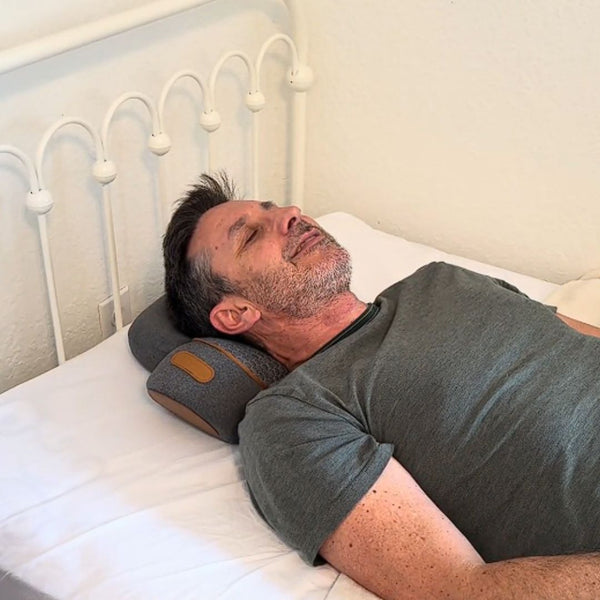
If you like to wind down lying down at the end of the day, the Thera Pillow is a cervical pillow with air-powered neck traction, heat and vibration massage. It has 3 heat levels (104°F, 111°F and 118°F), and short sessions are recommended. It's an optional comfort extra that sits alongside the exercises above.

A cervical pillow with air-powered neck traction, heat and vibration massage.
$129.00How long does it take to fix posture?
Most people need a few weeks of regular practice to notice a change in posture. An Ohio State physical therapist suggests giving a program 3 to 6 weeks to notice a difference. Harvard Health says more core strength and flexibility can improve posture noticeably in a few weeks.
The research supports exercise over the longer term. A 2024 review found that therapeutic exercise improved forward head, rounded shoulder and upper-back (thoracic kyphosis) angles in people with upper crossed syndrome. If you don't notice any change after a few weeks, Healthline suggests speaking with a healthcare professional.
When to stop and see a doctor
Posture correction exercises should feel like gentle effort or a mild stretch, never sharp pain. Stop any exercise that causes pain or strain.
Stop and see a doctor if
- You have numbness, tingling or weakness in your arm or hand.
- Your neck pain started after a fall, blow or injury, or it wakes you at night.
- Your back pain doesn't improve after a few weeks of home care, or your back has changed shape.
- You have pain, tingling, weakness or numbness in both legs, or new bladder or bowel changes. Call 911 or go to the emergency room.
- You have a fever and headache with a neck so stiff you can't touch your chin to your chest. Call 911.
A physical therapist can check your form and build a program around your body.
This article is for general information and isn't medical advice. Talk to your doctor or a physical therapist before starting a new exercise routine, especially if you have an injury or a health condition.
FAQ
What is the best exercise for posture?
There's no single best exercise for posture. Healthline's guide says the best exercise is one you're comfortable doing regularly. A balanced routine pairs a neck move (chin tucks), an upper-back move (rows or wall angels) and a core move (bridges or planks) with stretches for your chest and hips.
How often should you do posture exercises?
Do strengthening posture exercises about 3 times a week, with a rest day between sessions. Stretches can be done at least twice a week. Between sessions, change position every 20 to 30 minutes.
Can you fix years of bad posture?
Posture can often improve with steady work over several weeks. A 2024 review found that exercise programs improved head, shoulder and upper-back posture angles. Some changes need a professional look. The NHS advises seeing a doctor if your back has changed shape.
Can bad posture cause back pain?
Bad posture can contribute to aches, but it's rarely the whole story. Cleveland Clinic notes that poor posture in one area can cause aches elsewhere, and the NHS lists sitting at a desk for a long time as a cause of neck pain. Hinge Health's physical therapists point out that there's no hard evidence that posture on its own causes pain.
Sources
- Cleveland Clinic Health Essentials, "8 Posture Exercises To Sit and Stand Straighter" (with Jennifer Danzo, DPT; 5 Apr 2024). https://health.clevelandclinic.org/posture-exercises (accessed 11 Nov 2026)
- Bell L, PT (The Ohio State University Wexner Medical Center), "6 exercises to help correct poor posture" (19 Sep 2019). https://wexnermedical.osu.edu/blog/6-exercises-to-improve-posture (accessed 11 Nov 2026)
- Harvard Health Publishing, "Why good posture matters" (24 Jan 2017). https://www.harvardhealth.org/staying-healthy/why-good-posture-matters (accessed 11 Nov 2026)
- Hinge Health, "What is 'good posture'? Tips from physical therapists" (quotes Julianne Payton, PT, DPT; 15 Nov 2023). https://www.hingehealth.com/resources/articles/good-posture/ (accessed 11 Nov 2026)
- Hinge Health, "How to improve posture: 9 exercises and tips" (reviewed by Christynne Helfrich, PT, DPT, and Mary Kimbrough, PT, DPT; 3 Jul 2025). https://www.hingehealth.com/resources/articles/how-to-improve-posture/ (accessed 11 Nov 2026)
- Healthline, "Posture Exercises: 12 Exercises to Improve Your Posture" (written by Emily Cronkleton; medically reviewed by Micky Lal, MA, CSCS, RYT; updated 14 Oct 2026). https://www.healthline.com/health/posture-exercises (accessed 11 Nov 2026)
- NHS, "Flexibility exercises" (last reviewed 20 Nov 2023). https://www.nhs.uk/live-well/exercise/strength-and-flexibility-exercises/flexibility-exercises/ (accessed 11 Nov 2026)
- ColumbiaDoctors Health Library, "Alternate arm and leg (bird dog)" (content by WebMD Ignite; current as of 1 May 2026). https://www.columbiadoctors.org/health-library/multimedia/alternate-arm-leg-bird-dog/ (accessed 11 Nov 2026)
- Sepehri S, Sheikhhoseini R, Piri H, Sayyadi P. "The effect of various therapeutic exercises on forward head posture, rounded shoulder, and hyperkyphosis among people with upper crossed syndrome: a systematic review and meta-analysis." BMC Musculoskelet Disord. 2024;25(1):105. PMID 38302926. https://pubmed.ncbi.nlm.nih.gov/38302926/
- MedlinePlus Medical Encyclopedia, "Neck pain" (U.S. National Library of Medicine; reviewed 14 Jan 2026). https://medlineplus.gov/ency/article/003025.htm (accessed 11 Nov 2026)
- NHS, "Back pain" (last reviewed 5 Mar 2026). https://www.nhs.uk/conditions/back-pain/ (accessed 11 Nov 2026)
- NHS, "Neck pain" (last reviewed 27 Apr 2023). https://www.nhs.uk/conditions/neck-pain/ (accessed 11 Nov 2026)