How to decompress your spine at home comes down to a few gentle stretches and positions, such as child's pose, cat-cow and lying with your legs up on a chair. At home, spinal decompression is a non-surgical way of gently stretching the spine to relieve pressure on the discs between your vertebrae and on nearby nerves. These moves can ease the stiffness that builds up after long hours of sitting. Research on decompression and traction for back pain is mixed, so treat them as comfort and mobility moves, not a cure. If you have osteoporosis, a spinal fracture, spinal surgery, or numbness or weakness in your legs, ask a doctor first.
Below: 7 moves with hold times, a 10-minute routine, sleeping positions, the research and who should skip it.
Key takeaways
- At home, spinal decompression means gentle stretches and positions such as child's pose and cat-cow.
- Research on traction for back pain is mixed, so treat these moves as comfort and mobility, not a cure.
- Stop any move that makes your pain worse.
- Ask a doctor first if you have osteoporosis, a spinal fracture, spinal surgery, or numbness or weakness in your legs.
What spinal decompression means
Spinal decompression describes different types of treatment that aim to ease back pain by taking pressure off the nerves of your spine. Your spine is made of bones called vertebrae, with ligaments and spinal discs between them, and a nerve pathway runs down the middle. Gravity compresses the spine whenever you sit or stand, which over time can add to poor posture and back pain.
Spinal decompression comes in 3 forms:
- At-home stretches and positions. Gentle moves you do yourself, covered below.
- Clinical traction. A healthcare provider uses pulleys, weights and a traction table, or an inversion table, to stretch your spine.
- Surgery. A diskectomy or laminectomy removes disc or bone tissue to relieve pressure on a nerve, usually after less invasive options.
7 ways to decompress your spine at home
Not every move suits everyone. Stop straight away if a move increases your pain or sends symptoms down your legs or arms.
- Child's pose (prayer stretch). Start on your hands and knees, sit back until your bottom touches your heels, and reach both arms forward on the floor. Hold for 10 seconds. Repeat with your arms reaching slightly left, then slightly right, 3 times in each direction.
- Cat-cow. On hands and knees (knees under hips, hands under shoulders), slowly round your back toward the ceiling and look toward your knees. Then let your back sag gently while you look up. Repeat 20 to 30 times.
- Legs on a chair (90/90). Lie on your back on the floor and rest your lower legs on a chair seat, with the edge of the seat behind your knees. Relax there for at least 5 minutes, or as long as it feels comfortable. It isn't true decompression, but it takes some stress off your lower back.
- Knee to chest. Lie on your back with your knees bent. Hold one knee and gently pull it toward the same shoulder, keeping your shoulders down. Pause for a couple of seconds, then release. Do 5 on each side, and try both knees together once that feels comfortable.
- Bar hang (only if your shoulders allow it). Hold a sturdy pull-up bar (use a small step to reach it). Slowly let more of your weight hang and relax for 20 to 30 seconds, or whatever is comfortable. Repeat 2 to 3 times. Skip it if it hurts your shoulders.
- Countertop lean. Hold the kitchen sink or a sturdy countertop. Lean back slowly until your elbows are straight and your weight is behind you. Hold for 20 to 30 seconds while you breathe deeply, and repeat 2 to 3 times.
- Lying on your front and a gentle press-up (if comfortable). Lie flat on your front, with 1 or 2 pillows under your hips if flat hurts. When that's comfortable, put your hands under your shoulders and straighten your arms so your upper body lifts while your hips stay down. Partly straight is fine. Repeat up to 10 times.
A good sign is pain that eases or moves toward the middle of your back. A bad sign is pain that gets worse or moves into your buttock or leg: stop that move.
A 10-minute evening routine
A 10-minute evening routine strings 5 of the moves together and ends lying down. Rest for about 30 seconds between moves if you need to.
| Time | Move | What to do |
| 0:00-1:00 | Cat-cow | 20 to 30 slow repeats |
| 1:00-2:30 | Child's pose | 10 seconds forward, left and right, 3 times each |
| 2:30-3:30 | Knee to chest | 5 on each side |
| 3:30-5:00 | Press-up (if comfortable) | Up to 10 |
| 5:00-10:00 | Legs on a chair | Relax for at least 5 minutes |
If your back feels tight first, the NHS suggests a heat pack wrapped in a towel to relieve stiffness. Here's how to use a heating pad on your lower back safely.
How to decompress your spine while sleeping
To decompress your spine while sleeping, choose a position that keeps your lower back relaxed. An NHS hospital leaflet suggests these comfortable positions for low back pain:
- On your back with a pillow or two under your knees.
- On your side with a pillow between your knees. A rolled-up towel around your waist sometimes helps too.
- On your front with 1 or 2 pillows under your hips if lying flat hurts.
Your spine also regains some height on its own while you lie down. In a small study of 8 men, they were tallest on waking, and 71% of the overnight gain came in the first half of the night. For more on positions and support, see our guide to sleeping positions for lower back pain.
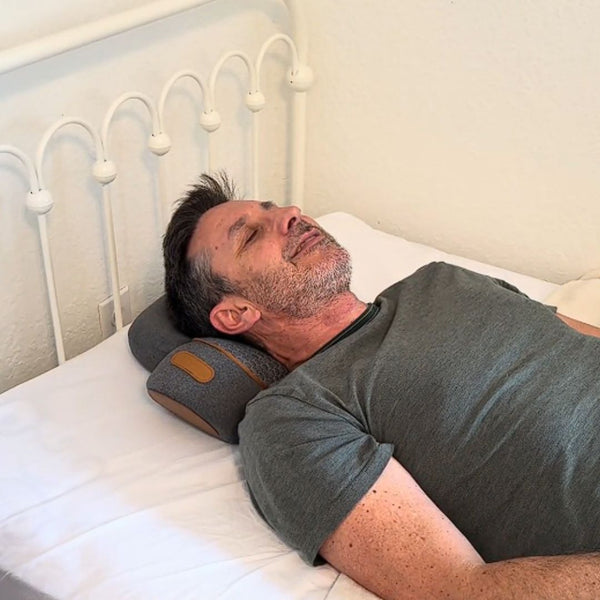
If you'd like a set wind-down session before bed, the Thera Back Pillow is a back cushion with 3 modes: traction, heat and vibration. Its traction lifts at a 26° angle. It measures 23.6" x 9.8" x 4.7", and the recommended use is 30 minutes. It's a comfort product, not a medical treatment, so keep up the stretches above and read the "when not to" list below first.

A back pillow with 3 modes: traction, heat and vibration.
€99,00Does spinal decompression actually work?
The research on spinal decompression is mixed, and the largest review is not encouraging for traction. A Cochrane review of 32 trials with 2,762 people found that for mixed low back pain, traction may make little or no difference to pain, function, overall improvement or return to work, compared with placebo, sham traction or no treatment. For low back pain with sciatica, traction probably has no impact on pain, function or overall improvement. The evidence was rated low to moderate quality, and 7 of the 32 trials reported side effects such as increased pain.
Inversion has one small, more hopeful trial. In 24 people waiting for surgery on a single lumbar disc, surgery was avoided in 10 of 13 who added inversion to physiotherapy, against 2 (22.2%) of those with physiotherapy alone. Pain and disability scores did not differ significantly between the groups, and the authors called for a larger trial.
Back Intelligence's physical therapists sum up the research as "inconclusive". Staying active and doing gentle exercises and stretches remain standard NHS advice for back pain.
When not to decompress your spine
Don't try decompression at home before talking to your doctor if you have:
- Osteoporosis
- A spinal fracture
- Spinal fusion surgery or an artificial disc in your lower back
- Pregnancy
- A diagnosed herniated disc, spondylolisthesis or a trapped nerve root
Skip inversion tables if you have high blood pressure that isn't under control, glaucoma, a hernia, dizziness, osteoporosis or fractures, or heart or circulation problems.
Stop and see a doctor if
- Your pain hasn't improved after a few weeks of home care.
- Pain spreads down a leg, or you have numbness, tingling or weakness in an arm or leg.
- Your pain is worse at night or when you cough or sneeze, or you feel hot, shivery or unwell.
- You have pain, tingling, weakness or numbness in both legs, numbness around your genitals or bottom, or new bladder or bowel changes. Call 911 or go to the emergency room.
Inversion tables and clinical decompression
An inversion table is a type of traction that uses gravity: you lie on a table that tilts your body to relieve pressure on your spine. Clinical traction uses pulleys, weights and a traction table, applied by a healthcare provider. Back Intelligence's physical therapists say there is little to no evidence that inversion tables work. If you do try one, follow its instructions, secure your feet, tip back slowly and stop if you feel very dizzy or light-headed. Ask a physical therapist or doctor before you buy one.
For stretches for the rest of your back, try these upper and mid-back stretches.
FAQ
Can you decompress your spine every day?
Gentle moves like these can be part of most days. Back Intelligence's physical therapists suggest several of them multiple times a day, while Healthline suggests a full routine a few times per week. Stop any move that makes your pain worse.
How do you know if your spine needs decompressing?
There's no home test. Stiffness after long hours of sitting or standing is common and is what these gentle moves are for. Pain that spreads down a leg, or numbness, tingling or weakness in a limb, is different: get it checked by a doctor or spine specialist before you try decompression.
Can decompressing your spine make you taller?
Not for long. Your height naturally changes through the day: in one small study it varied by 19.3 mm (about three quarters of an inch), and over half of the overnight gain was lost within an hour of getting up.
How do you decompress your neck?
Your neck has its own stretches and devices, and the same rule applies: go gently and stop if symptoms spread into your arm. Our step-by-step neck traction guide covers the steps and when to check with a clinician.
Sources
- Cleveland Clinic, "Spinal Decompression Therapy" (medically reviewed; last updated 18 Jan 2022). https://my.clevelandclinic.org/health/treatments/10874-spinal-decompression-therapy (accessed 9 Nov 2026)
- Back Intelligence, "Spinal Decompression At Home - Benefits & Exercises" (Dr. Nicole Lombardo, PT, DPT, CSCS, and Dr. Julianne Payton, DPT; last updated 3 Jul 2023). https://backintelligence.com/spinal-decompression-at-home/ (accessed 9 Nov 2026)
- Royal Berkshire NHS Foundation Trust, Emergency Department, "Low back pain" patient leaflet (reviewed and updated March 2026; next review March 2028). https://www.royalberkshire.nhs.uk/media/xxnf2e1w/low-back-pain_mar26.pdf (accessed 9 Nov 2026)
- Healthline, "12 Spinal Decompression Exercises for All Skill Levels" (written by Emily Cronkleton; medically reviewed by Courtney L. Gilbert, PT, DPT; updated 14 Oct 2026). https://www.healthline.com/health/spinal-decompression-exercises (accessed 9 Nov 2026)
- NHS, "Back pain" (page last reviewed 5 Mar 2026). https://www.nhs.uk/conditions/back-pain/ (accessed 9 Nov 2026)
- Reilly T, Tyrrell A, Troup JD. "Circadian variation in human stature." Chronobiol Int. 1984;1(2):121-126. PMID 6600017. https://pubmed.ncbi.nlm.nih.gov/6600017/
- Wegner I, Widyahening IS, van Tulder MW, Blomberg SE, de Vet HC, Brønfort G, Bouter LM, van der Heijden GJ. "Traction for low-back pain with or without sciatica." Cochrane Database Syst Rev. 2013;(8):CD003010. PMID 23959683. https://pubmed.ncbi.nlm.nih.gov/23959683/
- Prasad KS, Gregson BA, Hargreaves G, Byrnes T, Winburn P, Mendelow AD. "Inversion therapy in patients with pure single level lumbar discogenic disease: a pilot randomized trial." Disabil Rehabil. 2012;34(17):1473-1480. PMID 22263648. https://pubmed.ncbi.nlm.nih.gov/22263648/
- Southern California Orthopedic Institute (SCOI), "How To Decompress the Spine Safely With Orthopedic Experts" (posted 24 Sep 2025). https://scoi.com/blog/how-to-decompress-spine/ (accessed 9 Nov 2026)