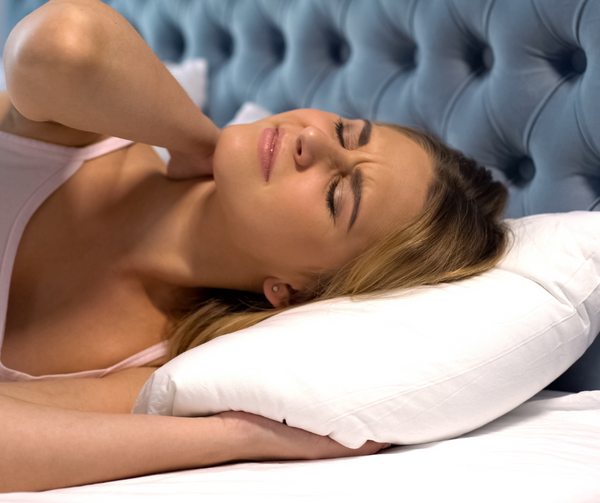
Neck pain from sleeping is usually a strained muscle or ligament from holding your neck at an awkward angle for hours, often because of stomach sleeping or a pillow that's too high or too flat. It typically eases within a few days. A pillow that keeps your head level with the rest of your spine is the main way to stop it from happening again.
Below: why it happens, how to ease it this morning, and the sleep setup that helps you stop waking up sore.
Key takeaways
- Neck pain from sleeping is usually a strained muscle from an awkward position or the wrong pillow height.
- It typically eases within a few days with gentle movement, and cold then heat.
- Back and side sleeping are easiest on the neck; stomach sleeping is the hardest.
- Keep your head level with your spine, and see a doctor if pain lasts a week or comes with numbness or fever.
Why your neck hurts after sleeping
A "crick" in the neck usually happens when the muscles and ligaments around the neck part of your spine get strained. At night, the usual culprits are:
- Your position. Sleeping on your stomach forces your neck to stay turned to one side for hours. The NHS names a neck "locked in an awkward position while sleeping" as one of the most common causes of neck pain.
- Your pillow's height. A pillow that's too high or too stiff keeps your neck bent all night, which Harvard Health links to morning pain and stiffness. One that's too flat lets your head drop.
- An old pillow or mattress. Feather pillows collapse over time and need replacing about every year. The NHS recommends a firm mattress.
- What you did during the day. Poor posture, especially from phone and computer use, adds strain that you then carry to bed. If that sounds familiar, our guide to tech neck explains the pattern.
- Dozing off upright. Falling asleep in a chair, car or plane lets your head drop to one side. A horseshoe-shaped travel pillow can help, as long as it isn't so big behind your neck that it pushes your head forward.
Sleep quality matters too. In a study of 4,140 adults described by Harvard Health, people with several kinds of sleep problems were more likely to develop chronic muscle and joint pain a year later.
How to ease a crick in your neck this morning
Cleveland Clinic notes that a stiff neck is almost always temporary, from overusing your neck or sleeping in an unusual position, and usually gets better on its own. To help it along:
- Keep your neck moving gently. Slowly tilt your head side to side and forward and back, avoiding fast or jerky movements. The NHS advises against wearing a neck collar, because it's better to keep your neck moving.
- Use cold, then heat. Texas Orthopaedic Associates suggests an ice pack in the first 24 hours, then a heating pad or warm shower to relax tight muscles. The NHS suggests a wrapped bag of frozen peas for 5 minutes, 3 times a day, or a wrapped hot water bottle for 20 minutes, 2 to 3 times a day.
- Try a light massage of the sore muscles to ease stiffness.
- Take care with driving. If you can't turn your head properly, don't drive or cycle until you can.
For more home remedies and the quick moves that help a stiff neck, see our guide to quick relief for a stiff neck.
Best sleeping position for neck pain
Harvard Health says two positions are easiest on the neck: on your side or on your back. Research backs this up, with limits. A 2019 review found side lying was generally protective against waking up with spinal pain and stiffness, but only 4 studies met the criteria, so the evidence is thin.
If you sleep on your back
Choose a rounded pillow that supports the natural curve of your neck, with a flatter pillow under your head. You can get the same effect by tucking a small neck roll into the pillowcase of a softer, flatter pillow.
If you sleep on your side
Use a pillow that's higher under your neck than under your head, so your spine stays straight. The aim is for your head to stay level with the rest of your body. A pillow between your knees can also stop you rolling forward.
If you sleep on your stomach
Stomach sleeping is hard on your spine, because your back arches and your neck stays turned. The NHS advises against it. Sleep habits are hard to change, and we don't always wake in the position we fell asleep in, but it's worth starting the night on your back or side.
For more on how sleep positions affect the rest of your spine, read how your sleep position might be causing your back pain.
Choosing the right pillow height
A quick test: lie in your usual position and ask someone to look at you from the side, or take a photo. Your nose should line up with the middle of your chest, and your head shouldn't tilt up, down or toward the mattress.
- Memory foam shapes itself to your head and neck, and some cervical pillows use it.
- Feather pillows mould easily but flatten over time.
- Latex (rubber). In one study of 106 side sleepers who tried several pillow types, latex pillows did best for waking neck pain.
Our full guide to choosing a pillow for neck pain by sleep position goes through height, firmness and shape.
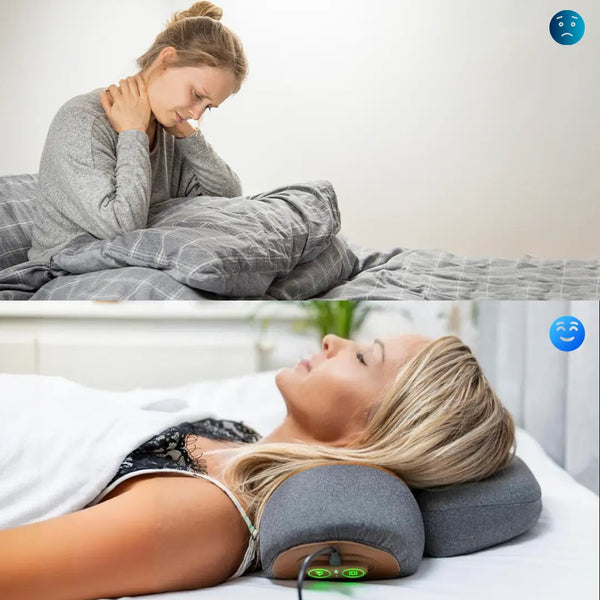
If you also want a dedicated neck-care session in your evening routine, the Callixe Thera Pillow combines air-powered neck traction, heat and vibration massage.

A cervical pillow with 3 modes: air-powered neck traction, heat and vibration massage.
£97.00A 3-night plan to stop waking up with neck pain
Small changes are easier to judge one at a time.
- Night 1: fix your position. Start the night on your back or side instead of your front.
- Night 2: fix your pillow height. Adjust it, or add a small neck roll, so your head stays level.
- Night 3: fix your evening. Put screens down a little earlier and do two gentle neck stretches before bed.
Each morning, note how your neck feels. If you've noticed no difference after a week or two of better sleep habits, look at your mattress, or ask a doctor or physical therapist.
When neck pain after sleeping needs a doctor
Most neck stiffness from sleeping wrong improves within a few days. See a doctor if:
- the pain is severe, or not improving after about a week
- you have numbness, tingling or weakness in your arms or hands
- you have headaches, or can't move your neck much
- painkillers haven't helped
- your pain started after a fall or accident
Get urgent care
If a stiff neck comes with a fever and headache. It can be a sign of meningitis, an infection that needs treatment right away.
For a fuller list of warning signs, see can neck pain be a sign of something serious?
FAQ
How long does neck pain from sleeping wrong last?
Usually a few days. See a doctor if it lasts longer than a week, or sooner if you have numbness, tingling or weakness.
Is heat or ice better for neck pain from sleeping?
For a fresh crick, Texas Orthopaedic Associates suggests ice in the first 24 hours, then heat to relax the muscles. Wrap either one in a cloth, keep sessions short, and never fall asleep with a heating pad on.
Can a bad mattress cause neck pain?
It can play a part. The NHS recommends a firm mattress as one way to prevent neck pain.
Why do I wake up with neck pain every morning?
Usually your sleep position, your pillow, or both. Stomach sleeping and a pillow that's too high are the usual suspects. Try the 3-night plan above. If nothing changes, see a doctor.
How to choose a pillow for neck pain
The right pillow is the biggest change most people can make. For a full guide, read pillow for neck pain: how to choose one for your sleep position.
This article is for general information and isn't a substitute for advice from your doctor or physical therapist. If you're unsure about your symptoms, get them checked.
Sources
- Cleveland Clinic, "Stiff Neck: Possible Causes, Relief & Remedies" (medically reviewed, last updated 12 Mar 2026). https://my.clevelandclinic.org/health/symptoms/24477-stiff-neck (accessed 4 Nov 2026)
- Harvard Health Publishing, "Say 'good night' to neck pain" (2 Feb 2022). https://www.health.harvard.edu/pain/say-good-night-to-neck-pain (accessed 4 Nov 2026)
- NHS, "Neck pain" (last reviewed 27 Apr 2023). https://www.nhs.uk/conditions/neck-pain/ (accessed 5 Nov 2026)
- Cary D, Briffa K, McKenna L. "Identifying relationships between sleep posture and non-specific spinal symptoms in adults: A scoping review." BMJ Open. 2019;9(6):e027633. PMID 31256029. https://pubmed.ncbi.nlm.nih.gov/31256029/
- Texas Orthopaedic Associates, "How to Relieve a Crick in Your Neck from Sleeping Wrong." https://www.txorthopaedic.com/blog/neck-pain-from-sleeping-wrong/ (accessed 4 Nov 2026)
- Gordon SJ, Grimmer-Somers K, Trott P. "Pillow use: the behaviour of cervical pain, sleep quality and pillow comfort in side sleepers." Man Ther. 2009;14(6):671-678. PMID 19427257. https://pubmed.ncbi.nlm.nih.gov/19427257/