Tech neck is neck and upper-back strain from looking down at phones, tablets and laptops for long stretches, which holds your head forward of your shoulders. It usually shows up as stiffness, aching and headaches. Raising screens to eye level, taking regular breaks and strengthening the upper back are the core fixes.
If your neck aches after an evening of scrolling, you're not alone. Tech neck is usually mild and responds well to simple changes. Here's what it is, how it feels, what helps and when to see a doctor.
Key takeaways
- Tech neck is neck and upper-back strain from looking down at screens for long stretches.
- It usually shows up as stiffness, aching and headaches.
- Raising screens to eye level, taking regular breaks and strengthening your upper back are the core fixes.
- If neck pain lasts more than two weeks, see a doctor.
What is tech neck?
Tech neck isn't a formal diagnosis. It's a common name for pain and stiffness that builds when you tilt your head down to look at a screen for a long time (UAB News). You may also hear it called "text neck". It's a type of forward head posture, which our guide on how to fix forward head posture at home covers in more depth.
Here's why looking down matters. Your head weighs about 10 to 12 pounds (Mayo Clinic Health System). As you tip it forward, the muscles at the back of your neck have to work harder to hold it up. NewYork-Presbyterian spine surgeon Dr. K. Daniel Riew says that at a 45-degree downward look, your neck muscles are doing work similar to lifting an almost 50-pound bag of potatoes (NewYork-Presbyterian). Cleveland Clinic's Dr. Andrew Bang puts it at upwards of 60 pounds when you read a phone held near your lap (Cleveland Clinic).
Phones and tablets are the main culprits, because they get held low, says Yale Medicine spine surgeon Dr. Peter Whang. Staying still makes it worse, which is why you often notice the stiffness only when you finally move (Yale Medicine).
Symptoms
Tech neck often reaches beyond the neck itself. Common signs include:
- Pain in the back of your neck
- Aching or tightness along the sides of your neck and into your shoulders
- Stiffness or less range of motion when you turn your head (our guide to stiff neck causes and relief has quick fixes)
- Headaches, or pain that creeps toward the base of your skull (read more on whether neck pain can cause headaches)
- Pain between the shoulder blades, or trouble looking up after looking down for a long time
Some people also feel it in the mid or lower back (Mayo Clinic Health System).
When to see a doctor
If neck pain lasts more than two weeks, Harvard Health suggests seeing your primary care doctor or an orthopedic specialist (Harvard Health). Get checked sooner if pain shoots into your shoulder or arm, or you have numbness, weakness, or trouble with balance or coordination (UAB News). Contact a medical professional right away for neck pain with fever, headache and a stiff neck together; loss of bowel or bladder control; chest pain or pressure; or neck pain so severe you can't sit still (Harvard Health).
How to fix tech neck
Most cases respond well to care at home (Yale Medicine).
- Raise your screen. Bring your phone, tablet or laptop up to eye level instead of bending your head down to it. For a computer, Mayo Clinic Health System suggests sitting about an arm's length (20 to 30 inches) from the screen and using a monitor or laptop stand so your eyes sit just above the top line of text. On the couch, rest your device on a pillow in your lap.
- Take breaks every 20 minutes. Stand, stretch or simply change position. Cleveland Clinic suggests keeping handheld sessions to no more than 15 to 30 minutes.
- Look up and move your neck. A few times a day, slowly turn your head to look up, down, left and right. Dr. Riew suggests lifting your head to look up every 10 to 15 minutes when you're working. Harvard Health advises turning side to side rather than rolling your neck.
- Do chin tucks. Sit tall, then slowly glide your head straight back, tucking your chin in. Keep your head level; don't nod. Hold for 3 to 5 seconds, release, and repeat 10 times. Do them daily at first, then a few times a week (Harvard Health).
- Strengthen your upper back. Squeeze your shoulder blades together, 3 sets of 10 daily, and stretch your chest in a doorway for 20 to 30 seconds, two to three times a day (Cleveland Clinic). Our stretches for upper back pain add more options.
- Use heat or ice for flare-ups. Use whichever feels better. A warm compress can ease tight muscles.
- Check your sleep setup. Sleeping on your back or side is easiest on the neck. Avoid a pillow that's too high or stiff, which keeps your neck bent overnight (Harvard Health). See our guide on how to sleep to fix rounded shoulders for back and side sleeper setups.
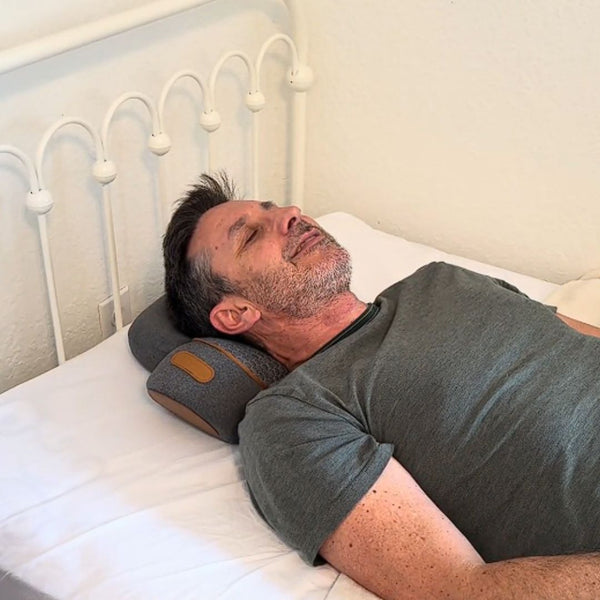
Optional support: the Thera Pillow is a cervical pillow with three modes: air-powered traction lift at a 26° angle, heat, and vibration massage with 4 patterns. It switches off automatically at 30-minute intervals, comes with a 90-night money-back guarantee and is FSA/HSA eligible in the US. It's an extra for comfort, not a replacement for the habits above.

A cervical pillow with 3 modes: air-powered traction at a 26° angle, heat and vibration massage.
$129.00If symptoms last after several weeks of self-care, a physical therapist can help with habits and lingering pain.
Can you reverse it?
For most people, the strain itself eases. Yale Medicine describes tech neck as usually mild and self-limited, meaning it improves once posture habits change (Yale Medicine). Exercise helps too. A review of seven randomized trials (627 participants) found therapeutic exercise led to large changes in a common measure of forward head posture and moderate improvement in neck pain, though the link between posture and pain is still not fully understood (Sheikhhoseini et al., 2018).
Longer-term changes are different. Dr. Whang says years of this posture may raise the risk of wear in the discs and joints of the neck. Cleveland Clinic adds that persistent strain can contribute to arthritis. Habit changes and exercise target muscle strain and posture; they aren't shown to undo wear in the spine. A doctor or physical therapist can help you manage that.
There's no set timeline. Stick with the habits for several weeks, and get checked if symptoms persist.
Tech neck hump
A "tech neck hump" usually means a rounded bump where your neck meets your upper back. Cleveland Clinic says the posture-related kind is a form of kyphosis, and that poor posture is its most common cause (Cleveland Clinic). Other causes include osteoporosis with compression fractures and age-related changes in the spine. A similar-looking buffalo hump is a fat deposit often linked to Cushing's disease.
So see your primary care provider first to rule out other causes. For a posture-related hump, Cleveland Clinic recommends chin tucks and shoulder-blade squeezes (3 sets of 10 daily) plus doorway chest stretches. Progress can take months. Our look at whether a pillow can get rid of a neck hump explains what support can and can't do.
FAQ
What is tech neck?
Tech neck is neck, shoulder and upper-back pain or stiffness caused by looking down at phones, tablets or computers for long periods. It isn't an official medical term, but it's a common, usually mild posture problem.
How do you get rid of tech neck?
You get rid of tech neck by raising screens to eye level, taking breaks every 20 minutes and moving your neck in every direction. Add chin tucks and upper-back exercises, and see a doctor if pain lasts more than two weeks.
Can you reverse tech neck?
Tech neck strain usually improves once your posture habits change, and exercise can improve forward head posture. Wear in the discs or joints from many years of strain is different; habit changes aren't shown to undo it, so see a doctor if pain persists.
How do you fix a tech neck hump?
A tech neck hump is best checked by your doctor first, because osteoporosis and other conditions can cause one. For a posture-related hump, Cleveland Clinic recommends chin tucks, shoulder-blade squeezes and chest stretches, with results taking months.
Is tech neck permanent?
Tech neck is usually temporary. Yale Medicine says it is not likely to cause serious damage or need surgery. Get checked if pain spreads into your arms.
Sources
- UAB News, University of Alabama at Birmingham - "Tech neck: How does the use of technology impact your neck?" (expert: Luke Hiatt, MD; 14 May 2025). https://www.uab.edu/news/news-you-can-use/tech-neck-how-does-the-use-of-technology-impact-your-neck (accessed 30 Oct 2026)
- Mayo Clinic Health System - "'Tech neck': Technology's effect on your neck" (Brian Langenhorst, 10 Apr 2024). https://www.mayoclinichealthsystem.org/hometown-health/speaking-of-health/effect-of-technology-on-your-neck (accessed 30 Oct 2026, read in a browser; scripts get a 403)
- NewYork-Presbyterian Health Matters - "How to Prevent and Fix 'Tech Neck'" (medically reviewed by Dan Riew, MD; published 14 Oct 2025, updated 11 May 2026). https://www.nyp.org/healthmatters/how-to-prevent-tech-neck (accessed 30 Oct 2026)
- Cleveland Clinic Health Essentials - "Tech Neck: A Modern-Day Pain" (expert: Andrew Bang, DC; 19 Nov 2025). https://health.clevelandclinic.org/tech-neck (accessed 30 Oct 2026)
- Yale Medicine - "What Is Tech Neck—and How Can You Prevent It?" (expert: Peter G. Whang, MD; 29 May 2026). https://www.yalemedicine.org/news/what-is-tech-neck-and-how-can-you-prevent-it (accessed 30 Oct 2026)
- Harvard Health Publishing - "Do habits cause your neck pain?" (1 Jun 2016). https://www.health.harvard.edu/pain/do-habits-cause-your-neck-pain (accessed 30 Oct 2026)
- Harvard Health Publishing - "When to seek immediate medical attention for neck pain" (31 Jan 2024). https://www.health.harvard.edu/pain/when-to-seek-immediate-medical-attention-for-neck-pain (accessed 30 Oct 2026)
- Cleveland Clinic Health Essentials - "Dowager's Hump: What It Is and How To Get Rid of It" (expert: Candice Price, DC; 11 Apr 2023). https://health.clevelandclinic.org/how-you-can-fix-a-dowagers-hump-prevention-tips/ (accessed 30 Oct 2026)
- Harvard Health Publishing - "Say 'good night' to neck pain" (2 Feb 2022). https://www.health.harvard.edu/pain/say-good-night-to-neck-pain (accessed 30 Oct 2026)
- Sheikhhoseini R, Shahrbanian S, Sayyadi P, O'Sullivan K. "Effectiveness of Therapeutic Exercise on Forward Head Posture: A Systematic Review and Meta-analysis." Journal of Manipulative and Physiological Therapeutics, 2018. PMID 30107937, doi:10.1016/j.jmpt.2018.02.002. https://europepmc.org/article/MED/30107937 (abstract, accessed 30 Oct 2026)