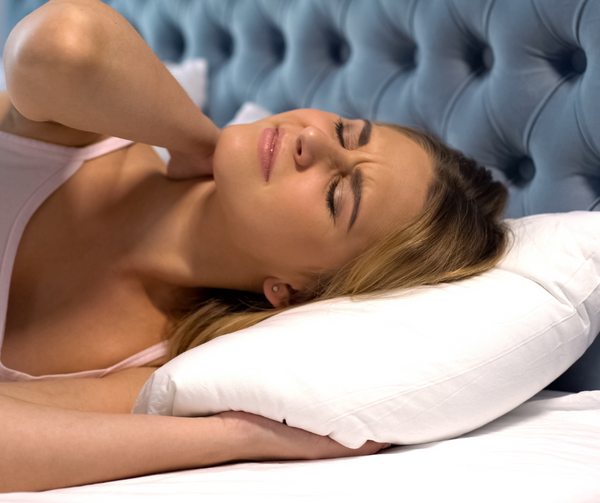
Sleeping to help rounded shoulders means choosing a position that lets your shoulders rest open instead of rolled forward. Back sleeping with a supportive neck pillow is the usual starting point; side sleepers can hug a pillow so the top shoulder doesn't collapse forward. Sleep position supports your daytime exercises rather than replacing them.
You stretch, you fix your desk setup, you remind yourself to sit tall. Then you wake up with your shoulders curled toward your chest again. That's frustrating, but it's also useful information. You spend many hours in bed every night, so the way you lie there is worth a few small changes.
This guide walks you through the back and side sleeping setups that keep your shoulders in a more open, relaxed position, the pillow details that matter, and the daytime exercises that do the real work.
Key takeaways
- Sleep position can't fix rounded shoulders, but it can stop you undoing your daytime work.
- On your back, use a low, firm pillow and small pillows under your arms so both shoulders rest open.
- On your side, hug a pillow and put one between your knees so your top shoulder stays stacked.
- Avoid sleeping on your front, and pair your sleep setup with daily stretching and strengthening.
Can sleep position affect rounded shoulders?
Rounded shoulders usually come from daytime habits: sitting, driving, looking down at a phone and working at a laptop. Healthline describes the pattern as tight chest muscles and tight neck and shoulder muscles pulling the shoulders forward, often called "upper crossed syndrome". Over time your body gets used to that shape.
Sleep doesn't create that pattern on its own, but it can either let your shoulders rest in a neutral position or hold them in the same curled shape for hours. If you sleep curled on your side with your top shoulder rolled forward, you're spending the whole night in the position you're trying to move away from during the day.
It's worth being honest about the evidence. The best sleeping position for rounded shoulders hasn't been firmly established, and more research is needed on how sleep position and spine symptoms are linked. One small study filmed 53 adults sleeping at home and found that people who woke with neck symptoms spent more of the night in "provocative" postures, such as twisted side lying and lying on the front, and also reported poorer sleep. The authors are clear that this doesn't prove sleep posture causes those symptoms.
So treat your sleep setup as support. It can make mornings more comfortable and stop you undoing your daytime work, but it won't change your posture by itself.
Best position: back sleeping setup
For most people, back sleeping is the easiest position for keeping both shoulders open and even. Cleveland Clinic notes that back sleeping is often the most comfortable position for people with neck or back pain, and that a supportive pillow under your neck can help.
Here's how to set it up:
- Choose a pillow that keeps your head level. The NHS advises that your head should be the same height as the rest of your body when you sleep, and suggests a low, firm pillow for neck pain. A tall stack of pillows pushes your chin toward your chest, which pulls your head and shoulders forward.
- Support the curve of your neck. A pillow that fills the gap under your neck, rather than just propping up the back of your head, helps your neck rest in its natural curve.
- Prop your arms slightly. If your shoulders tend to roll inward when your arms lie flat, place a small pillow or folded towel under each forearm or upper arm. A slight lift lets your shoulders settle back.
- Keep both sides even. Cleveland Clinic recommends keeping both arms in similar positions so you don't strain one side of your body. Avoid tucking one arm under the pillow and leaving the other by your side.
- Add a pillow under your knees. This takes pressure off your lower back and can make back sleeping easier to stick with.
If back sleeping feels strange at first, give it time. Start each night on your back and don't worry if you wake up in another position. Your body may take a few weeks to settle into it.
If you sleep on your side
Side sleeping is common and comfortable for many people, and it has real benefits. Cleveland Clinic points out that it can help with snoring and sleep apnea, and is advised as much as possible during pregnancy. If you're a side sleeper, you don't have to switch. You just need to stop your top shoulder and arm from collapsing forward across your chest.
- Hug a pillow. Hold a medium-firm pillow against your chest. It gives your top arm somewhere to rest so the shoulder stays stacked above the bottom one instead of rolling forward.
- Keep your head level with your spine. Your pillow should fill the space between your ear and the mattress so your neck doesn't tilt down toward the bed or up toward the ceiling. Broad shoulders usually need a taller pillow than narrow ones.
- Put a pillow between your knees. This stops your top leg sliding forward and twisting your spine. In the sleep-camera study above, side lying only counted as "provocative" when the top thigh was pushed forward; when pillows supported the top thigh, the spine wasn't twisted.
- Don't sleep on your arm. Keep your bottom arm in front of you, not tucked under your body or pillow, so your bottom shoulder isn't squashed forward.
- Switch sides. If you always sleep on the same side, alternate when you can so one shoulder isn't always taking the load.
What about stomach sleeping?
Stomach sleeping is the hardest position on your neck and shoulders. Cleveland Clinic says it isn't recommended for most people and can contribute to back, neck and shoulder pain, and the NHS advises against sleeping on your front if you have neck pain. Your head has to turn to one side for hours, and your shoulders often roll inward to make room. If you're a stomach sleeper, try moving to your side with a body pillow in front of you; it gives a similar "pressed against something" feeling.
Does side sleeping cause rounded shoulders?
Side sleeping on its own isn't known to cause rounded shoulders. We couldn't find a study showing that, and Cleveland Clinic presents side sleeping as a healthy choice for many people. The issue is the version of side sleeping where you curl up tight, your top shoulder drops forward, and your arm reaches across your body. Repeat that every night and your shoulders spend hours in the same forward position as your day.
Signs your side sleeping may be working against you:
- You wake up with a stiff neck or a sore front of the shoulder.
- You notice your top arm is hanging off the front of your body in the morning.
- You always sleep on the same side and that shoulder feels tighter.
- You sleep curled in a tight ball.
If that sounds like you, the setup in the section above (a hug pillow, a level head pillow and a knee pillow) is usually enough to keep your shoulders more open. If you're a woman over 40 and finding that your sleep position needs are changing, our guide to the best sleep positions for women over 40 covers more options.
Pillow setup
Your pillow does most of the work in both positions, because it decides where your head and neck sit, and your shoulders follow.
A few things to check:
- Height: Too high and your head is pushed forward; too low and your neck bends down. The NHS goal of keeping your head at the same height as the rest of your body is a good test. Ask someone to look at you from the side, or take a photo.
- Firmness: A pillow that flattens during the night lets your head sink, and your shoulders tend to roll with it. A firm pillow holds its shape.
- Shape: A contoured pillow with a raised neck area supports the natural curve of your neck, which many back sleepers find helpful.
- Extra pillows: A hug pillow for side sleeping, a knee pillow, and small arm pillows for back sleeping. You don't need special products for these; ordinary pillows or folded towels work.
If neck pain is also part of the picture, our guide to choosing a pillow for neck pain goes into more detail. And because rounded shoulders and a forward head often go together, you may also want to read whether a pillow can help a neck hump.
If you'd like a pillow that does more than hold your head, the Thera Pillow has three modes (air traction lift, heat and vibration massage), the traction lifts at a 26° angle, and it switches off automatically at 30-minute intervals. It's not a treatment for rounded shoulders, but if it helps you relax on your back, it can make the back-sleeping habit easier to build. It comes with a 90-night money-back guarantee, so you can see whether it suits you.

A cervical pillow with 3 modes: air-powered traction at a 26° angle, heat and vibration massage.
$198.00Daytime exercises to pair with it
Your sleep setup helps you avoid undoing your progress. The progress itself mostly comes from the daytime. Healthline notes that stretching and strengthening are the first-line approach for rounded shoulders, because they address the imbalance between tight chest muscles and weaker upper back muscles. The exercises below are among those it describes. Move slowly and stop if anything hurts.
- Doorway chest stretch. Stand in a doorway, rest your forearms on the frame at shoulder height and step one foot forward until you feel a gentle stretch across your chest. Hold for 20 to 30 seconds and breathe.
- Band pull-apart. Hold a light resistance band in front of you at shoulder height and pull your hands apart, squeezing your shoulder blades together. Return slowly.
- Scapular wall slides. Stand with your back against a wall, arms bent in a "goalpost" shape against the wall, and slowly slide them up and down while keeping contact with the wall.
- Prone I, T, Y. Lie on your stomach on the floor (this is an exercise, not a sleep position) and lift your arms in an I, then a T, then a Y shape, squeezing your upper back each time.
A few minutes of chest stretching before bed is a simple way to link your daytime and night-time habits. For a fuller routine, see our stretches for upper back pain. If your head also drifts forward when you sit, our guide on how to fix forward head posture at home covers the neck side of the same pattern.
How long change takes is different for everyone. It depends on how pronounced your rounded shoulders are, your daily habits and your overall health, and a physical therapist can give you a timeline for your situation.
When to see a doctor or physical therapist
Posture changes are usually something you can work on at home, but get checked if:
- Neck or shoulder pain doesn't improve after a couple of weeks, or keeps getting worse.
- Moving your arm or shoulder is very difficult.
- You have pins and needles, numbness or a cold arm.
- The pain started after a fall or injury, is sudden or severe, or comes with a fever or feeling unwell.
- Exercises cause pain rather than a gentle stretch.
A physical therapist can check what's driving your posture and give you exercises that suit your body.
FAQ
How do you correct rounded shoulders while sleeping?
You can't fully correct rounded shoulders while sleeping, but you can stop sleep from working against you. Sleep on your back with a supportive pillow that keeps your head level, with small pillows under your arms so your shoulders rest back. If you sleep on your side, hug a pillow and put one between your knees so your top shoulder stays stacked.
Does side sleeping cause rounded shoulders?
Side sleeping isn't known to cause rounded shoulders on its own. Curling up tightly with your top shoulder rolled forward every night can keep your shoulders in a forward position for hours, though. A hug pillow, a knee pillow and a head pillow at the right height help you side sleep with your shoulders more open.
What is the best sleeping position for rounded shoulders?
Back sleeping is usually the easiest position for keeping both shoulders open and even, but there's no single proven best position. A well-supported side position works for many people. Stomach sleeping is the one to avoid.
Can a pillow fix rounded shoulders?
A pillow can't fix rounded shoulders, but the right one helps your head, neck and shoulders rest in a neutral position overnight. Look for one that keeps your head at the same height as the rest of your body and stays firm through the night. Pair it with daytime stretching and strengthening.
How long does it take to improve rounded shoulders?
There's no set timeline. It depends on how pronounced your rounded shoulders are, your daily habits and your general health. Regular exercise and better sitting and sleeping habits all add up; a physical therapist can give you a realistic timeline.
Sources
- Cleveland Clinic Health Essentials, "What's the Best Sleep Position for You?" (7 Jan 2025). https://health.clevelandclinic.org/best-sleeping-position (accessed 28 Oct 2026)
- NHS, "Neck pain". https://www.nhs.uk/conditions/neck-pain/ (accessed 28 Oct 2026)
- NHS, "Shoulder pain". https://www.nhs.uk/conditions/shoulder-pain/ (accessed 28 Oct 2026)
- Cary D, Jacques A, Briffa K. "Examining relationships between sleep posture, waking spinal symptoms and quality of sleep: A cross sectional study." PLOS ONE, 2021 (correction 2024). https://journals.plos.org/plosone/article?id=10.1371/journal.pone.0260582 (accessed 28 Oct 2026)
- Healthline, "Rounded Shoulders Exercises" by Sara Lindberg, medically reviewed by Alissa Palladino, MS, RDN, LD, CPT (updated 14 Oct 2026). https://www.healthline.com/health/rounded-shoulders-exercises (accessed 28 Oct 2026)