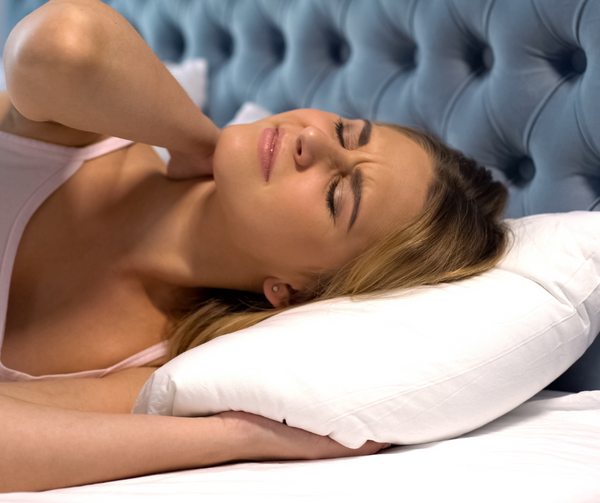
A stiff neck is tightness that makes it hard or painful to turn your head, most often from a muscle strain after sleeping awkwardly, poor posture or tension. It usually eases with heat, gentle movement and a break from the position that caused it. A stiff neck with fever, headache or sensitivity to light needs urgent medical care.
Below: what usually causes it, what you can do at home today, how to sleep with it, and the signs that mean you should see a doctor.
Key takeaways
- Most stiff necks come from a muscle strain after sleeping awkwardly, poor posture or stress, not from anything serious.
- Gentle heat, slow movement and a break from whatever caused it help most cases settle.
- Sleep on your back or side with a low, supportive pillow, and avoid sleeping on your front.
- Get urgent help if a stiff neck comes with fever, headache or sensitivity to light.
What causes a stiff neck?
Most stiff necks come from the muscles and soft tissues of the neck, not from anything serious. The usual triggers are:
- Sleeping awkwardly. Your neck can stay twisted or bent for hours while you sleep. The NHS names a neck "locked in an awkward position during sleep" as a common cause of neck pain and stiffness. Sleeping on your front is a classic one, because your head has to turn to one side all night.
- Posture and long hours in one position. Your head weighs about 12 pounds, according to Mass General Brigham, and your neck muscles work harder the further it drifts forward over a desk or phone.
- Stress and tension. When you're stressed, you tend to clench your shoulder and neck muscles without noticing. If your stiffness usually comes with tight shoulders, our guide to neck and shoulder tension and what helps at home goes deeper.
- A strain or sprain. Lifting with poor form, a sudden twist or an unusual workout can strain the muscles or ligaments in your neck.
- Injury. Whiplash from a car accident, a fall or a sports knock can cause stiffness. Stiffness after an injury is a different situation; see the warning signs below.
- Wear and tear. With age, the discs and joints in the neck change, and conditions such as osteoarthritis can add to stiffness.
- Infection (rare but serious). A stiff neck can be a sign of meningitis, an infection of the membranes around the brain and spinal cord, which needs prompt treatment.
How to fix a stiff neck at home
If your stiff neck came on after sleep, desk work or a long drive and you feel otherwise well, here's what to do for a stiff neck at home. Go gently, and stop anything that makes the pain sharper.
- Take a short break from what caused it. Cleveland Clinic suggests resting or avoiding the activity that caused the stiffness for a few days. The NHS advises you to keep your neck moving and not to wear a neck collar unless a doctor tells you to.
- Use heat to relax tight muscles. A warm shower, a warm compress or a heating pad can help the muscles loosen. Mass General Brigham advises putting a barrier between the pack and your skin and keeping each session to about 15 minutes; the NHS suggests a wrapped hot water bottle for up to 20 minutes, 2 to 3 times a day. Never fall asleep with a heating pad on your skin. If you prefer something hands-free while you sit, a wearable heat and massage wrap like the Callixe Thera Wrap is one option; follow the product instructions and keep sessions short.
- Consider cold first if it's a fresh strain. For a new strain, MedlinePlus suggests ice for the first 48 to 72 hours and heat after that. Wrap ice in a cloth; the NHS suggests about 5 minutes at a time, 3 times a day.
- Move your neck slowly through its range. MedlinePlus recommends slow range-of-motion exercises: up and down, side to side, and ear toward shoulder. Move only as far as feels comfortable, then come back to the middle.
- Try two simple stretches. Mass General Brigham describes chin tucks (pull your chin straight back so your ears line up over your shoulders) and low rows (squeeze your shoulder blades down and back), each held for about 30 seconds. Cleveland Clinic also suggests tilting your head toward the side opposite the stiffness.
- Break up long sitting. Change position about every 20 minutes: roll your shoulders, look side to side, or stand up and walk.
- Over-the-counter pain relief, if suitable for you. Cleveland Clinic and the NHS mention over-the-counter pain relievers such as ibuprofen. Follow the label, and check with a pharmacist or doctor first if you take other medicines or have a health condition. Cleveland Clinic advises checking with a provider before taking anti-inflammatories for more than 10 days in a row.
- Take care with driving and cycling. If you can't turn your head fully, the NHS advises avoiding activities that could be dangerous without full neck movement, such as driving or cycling.
If your neck keeps stiffening up week after week, it's worth looking at the bigger picture: your pillow, your desk set-up and how you sleep. Our guide on how to fix forward head posture covers the desk and screen side of it.

A wearable heat and massage wrap for your neck and shoulders.
$83.00View productIs there a 10-second fix?
Probably not. People often search for how to get rid of a stiff neck in 10 seconds, but none of the health sources we checked describe a 10-second fix. A tight, irritated muscle usually needs time to settle.
What you can do in about 10 seconds is take the edge off and start the recovery:
- Gently tilt your head away from the stiff side and breathe slowly for a few breaths.
- Do a slow chin tuck, then relax.
- Roll your shoulders back and down a few times to release some of the tension around your neck.
These can make your neck feel a little looser, but they won't undo the strain in one go. Be wary of anything that promises instant results, and avoid forcing your neck or "cracking" it quickly; Mass General Brigham advises against high-speed neck cracking. Cleveland Clinic notes that a stiff neck often gets better on its own, and the NHS says most neck pain only lasts a few weeks.
How to sleep with a stiff neck
The goal is simple: keep your neck in line with the rest of your spine.
- Sleep on your back or your side, not your front. Front sleeping forces your head to one side for hours, and both the NHS and Mass General Brigham advise against it.
- Keep your head level with your body. The NHS suggests keeping your head at the same height as the rest of your body and using a low, firm pillow. A pillow that's too high pushes your head forward or sideways.
- Support the gap under your neck. Mass General Brigham suggests placing a pillow under your head and supporting the natural gap at your neck, for example with a curved pillow. MedlinePlus also suggests a firm mattress with a pillow that supports your neck. Our guide on what to look for in a pillow for neck pain walks through height, firmness and shape.
- Side sleepers: keep your spine straight. Hugging a body pillow can stop you rolling forward and help keep your spine aligned. For more on how positions affect your back as well as your neck, read how your sleep position might be causing your back pain.
- Don't twist in bed. The NHS advises against twisting your neck in bed. When you turn over, try to move your head and shoulders together.
- No heat while you sleep. Use heat before bed if it helps you relax, but take the pack off before you fall asleep.
Some people with recurring stiffness also use a cervical traction pillow for short sessions. If you're thinking about trying one, read our step-by-step guide to using a neck traction pillow first, and check with your doctor or physical therapist if you have a diagnosed neck condition.

A cervical pillow with 3 modes: air-powered traction at a 26° angle, heat and vibration massage.
$194.00When a stiff neck is serious
Most stiff necks are not serious. But some symptoms mean you should get help quickly rather than wait it out.
Call 911 or go to the emergency room right away if your stiff neck comes with
- A fever and headache, especially if your neck is so stiff you can't touch your chin to your chest. This can be a sign of meningitis.
- Sensitivity to light, nausea or vomiting, confusion, unusual sleepiness or a rash of small, round spots.
- Sudden weakness or numbness in an arm, shooting pain down an arm, loss of balance, or loss of bladder or bowel control.
- You can't move an arm or hand after a fall, blow or injury.
- Chest pain or pressure, shortness of breath, sweating, or arm or jaw pain, which can be signs of a heart attack.
See your doctor soon if
- Your stiffness started after a fall, blow or injury, such as a car accident.
- You have numbness, tingling or weakness in an arm or hand.
- It hasn't improved after about a week of self-care, or you can't move your neck well and it has lasted more than a few days.
- Over-the-counter pain relief isn't helping.
- The pain is worse lying down or wakes you at night, or you have swollen glands or a lump in your neck.
- You have trouble swallowing or breathing along with the neck pain.
- You're simply worried about it.
For a longer walk-through of these signs, see can neck pain be a sign of something serious?
FAQ
What causes a stiff neck overnight?
Usually your neck spent hours in an awkward position, such as sleeping on your front or with your head twisted. Stress and long screen time can leave your muscles tight before bed.
How do you fix a stiff neck fast?
There's no instant fix. Take a break from the position that caused it, use gentle heat for short sessions, and move your neck slowly through a comfortable range.
How long does a stiff neck last?
A simple stiff neck often improves on its own within a few days, and the NHS says most neck pain only lasts a few weeks. MedlinePlus advises contacting your provider if symptoms don't go away after 1 week of self-care.
How should I sleep with a stiff neck?
Sleep on your back or side with a low, supportive pillow that keeps your head level with your body, and avoid sleeping on your front.
Is heat or ice better for a stiff neck?
Heat helps tight muscles relax and suits most everyday stiffness. For a fresh strain, MedlinePlus suggests ice for the first 48 to 72 hours, then heat. Wrap either one, keep sessions short, and never sleep with a heating pad on.
This article is for general information and isn't a substitute for advice from your doctor or physical therapist. If you're unsure about your symptoms, get them checked.
Sources
- Cleveland Clinic, "Stiff Neck." https://my.clevelandclinic.org/health/symptoms/24477-stiff-neck (accessed 28 Oct 2026)
- Mass General Brigham, "Stiff Neck Remedies." https://www.massgeneralbrigham.org/en/health-wellness/stiff-neck-remedies (accessed 28 Oct 2026)
- NHS, "Neck pain." https://www.nhs.uk/conditions/neck-pain/ (accessed 28 Oct 2026)
- OIB Orthopaedic Institute (oibortho.com), "Stiff Neck: Causes and Prevention." https://oibortho.com/stiff-neck-causes-and-prevention/ (accessed 28 Oct 2026)
- MedlinePlus (U.S. National Library of Medicine), "Neck pain." https://medlineplus.gov/ency/article/003025.htm (accessed 28 Oct 2026)
- Harvard Health Publishing, "When to seek immediate medical attention for neck pain." https://www.health.harvard.edu/pain/when-to-seek-immediate-medical-attention-for-neck-pain (accessed 28 Oct 2026)