Neck and shoulder pain usually comes from tension or strain in the muscles that link your neck to your shoulders and upper back, often from posture, stress or sleeping awkwardly. Heat, gentle stretching and regular movement breaks can help ease most everyday cases. Pain that spreads down your arm, or comes with numbness or weakness, needs a medical check.
If your neck feels tight by mid-afternoon and the ache creeps across the top of your shoulders, you're not alone. Neck pain is common, and most causes aren't serious. This guide covers why your neck and shoulders tend to hurt together, what you can do at home, how to tell whether the problem starts in your neck or your shoulder, a few gentle stretches, and the warning signs that mean you should see a doctor.
Key takeaways
- Most neck and shoulder pain comes from tight or strained muscles and isn't serious.
- Heat, gentle stretches and regular movement breaks ease most everyday cases.
- Pain that spreads past the elbow or feels electric often starts in the neck; pain when reaching overhead often starts in the shoulder.
- Chest pain, shortness of breath, or numbness and weakness with neck pain need medical help quickly.
Why your neck and shoulder hurt together
Your neck and shoulders share muscles, nerves and posture habits, so a problem in one area often shows up in the other. Cleveland Clinic lists stiffness in the neck, shoulders and upper back, and pain shooting from the neck into the shoulders or arms, among the symptoms of neck pain. Harvard Health notes that shoulder pain can also come from neck problems such as arthritis and disc herniations.
The most common triggers are everyday ones:
- Posture and screen time. Long hours looking at a screen, slouching and a poorly placed monitor all strain the neck muscles.
- Sleeping awkwardly. Your neck can stay twisted for hours at night, and the NHS names sleeping in an awkward position as a common cause of neck pain. If you wake up unable to turn your head, our guide to stiff neck causes and quick relief covers that in more detail.
- Stress. When you're stressed, you can tighten your neck and shoulder muscles without realizing it.
- How you carry and hold things. Carrying heavy loads on your shoulders, cradling your phone between your ear and shoulder and lifting with poor form all load the same muscles.
- Injury. Whiplash from a car accident or a fall can damage muscles, ligaments, discs or nerves.
- Wear and tear. With age, changes such as osteoarthritis, disc problems or a pinched nerve can cause neck pain that spreads to the shoulder or arm.
How to relieve neck and shoulder pain at home
If your pain came on after a long day at a desk, a bad night's sleep or a stressful week, and you feel otherwise well, these steps are a sensible place to start. Go gently and stop anything that makes the pain sharper.
- Use heat for tight muscles. Heat loosens muscles and improves blood flow. Cleveland Clinic suggests a hot shower, or a hot towel or heating pad on the lowest setting, for about 15 minutes every few hours. The NHS suggests a hot water bottle wrapped in a tea towel for up to 20 minutes, 2 to 3 times a day. Never fall asleep on a heating pad. If you'd like something hands-free while you sit, a wearable heat and vibration neck wrap such as the Callixe Thera Wrap is one optional way to add warmth. It's a comfort tool, not a treatment, so follow the product instructions.
- Try cold for a fresh strain. Right after an injury, Cleveland Clinic advises cold instead of heat. MedlinePlus suggests ice for the first 48 to 72 hours, then heat. Wrap ice or a bag of frozen peas in a towel; for the shoulder, the NHS suggests up to 20 minutes, up to 3 times a day.
- Keep moving, gently. You may need to ease off strenuous activity for the first few days, but don't stop moving altogether. The NHS advises keeping your neck moving, not wearing a neck collar unless a doctor tells you to, and gently moving your shoulder rather than resting it completely.
- Take a break every 30 minutes. Harvard Health suggests standing up, stretching or moving around every 30 minutes. Cleveland Clinic suggests stretching your whole body, neck included, during breaks from sitting.
- Set up your desk. Put your monitor at eye level so you aren't looking up or down, keep your feet flat on the floor and support your lower back. Keep your shoulders down and back rather than slouched. Use a headset or speakerphone instead of holding your phone with your shoulder. If your head tends to drift forward toward the screen, read how to fix forward head posture at home.
- Lighten the load on your shoulders. Avoid carrying heavy loads on your shoulders, and use wheeled luggage when you travel.
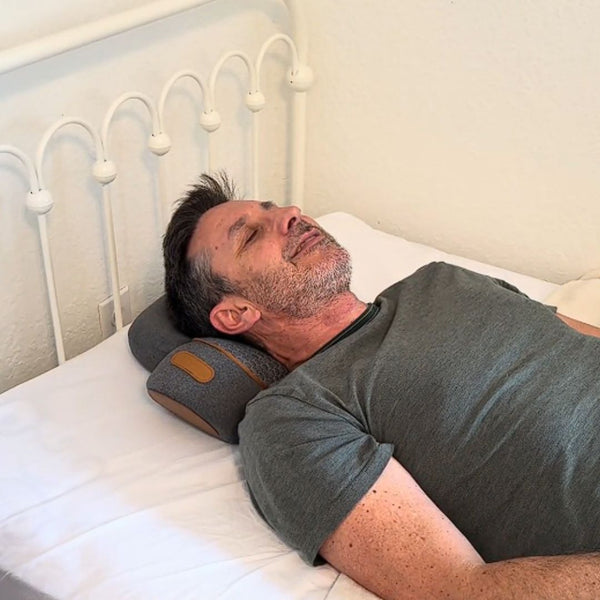
- Check your pillow and sleep position. The NHS suggests a low, firm pillow, keeping your head level with the rest of your body and not sleeping on your front. A pillow that's too high or too flat may leave your neck stiff. If you sleep on your back, a pillow under your knees can help.
- Make room for stress relief. Cleveland Clinic suggests mindfulness, meditation, breathing exercises and yoga to help reduce stress.
- Consider over-the-counter pain relief, if it's suitable for you. The NHS and MedlinePlus mention ibuprofen or acetaminophen (called paracetamol in the UK). Follow the label, and ask a pharmacist or doctor first if you take other medicines or have a health condition.

Most strain- and stress-related neck pain improves within one to two weeks, though it can take a few months to settle completely. Shoulder pain usually starts to ease after about 2 weeks of self-care. Everyone is different, so use these as rough guides rather than deadlines.
For a wider look at what helps, including pillows, posture and daily habits, see our complete guide to neck pain relief at home.
Is it your neck or your shoulder?
Pain that feels like it's in your shoulder can start in your neck, and the other way round. Cleveland Clinic orthopaedic surgeon Dr. Eric Ricchetti describes some patterns that can point one way or the other.
It may be coming from your neck if the pain
- Spreads to your shoulder blade, or sits near or on the side of your neck.
- Feels electric, stabbing, burning or tingling.
- Travels down past your elbow, or into your hand.
- Stays even when you're resting.
- Shoots down your arm when you tilt your head back or twist your neck.
- Eases when you support your neck.
It may be coming from your shoulder if the pain
- Sits in the shoulder itself or on the outside of your upper arm, and feels dull and aching.
- Comes on when you reach overhead or behind your back, or when you lift.
- Spreads into your upper arm but not past the elbow.
- Is there at night but eases when you rest your arm.
These clues overlap, and the same article says a proper exam by a specialist, including range-of-motion and strength tests, is what tells them apart. If your pain seems to sit mainly in the shoulder joint, our home remedies for shoulder pain go into shoulder-specific ideas.
Stretches for neck and shoulder pain
Gentle stretches can help you keep moving. You should feel a gentle stretch, not pain. Move slowly, don't bounce, and skip any stretch that makes your pain worse. Avoid sudden, forceful neck "cracking". If you have a serious neck injury or a pinched nerve, check with your doctor or physical therapist before starting.
- Chin tuck. Look straight ahead. Tuck your chin in slightly and glide your head straight back, keeping it level. Hold for 5 seconds and repeat 5 times.
- Neck tilt. Sit or stand tall. Slowly tilt your head toward your right shoulder and hold for 10 to 15 seconds. Return to the middle and repeat on the left. Do 5 on each side.
- Side-to-side turn. Turn your head to look over your right shoulder and hold for 10 seconds, then switch sides. Do 5 on each side.
- Shoulder rolls. Roll your shoulders forward in a circle 5 times, then backward 5 times.
- Shoulder blade squeeze. Pinch your shoulder blades together, then relax. Repeat 10 times.
- Cross-body shoulder stretch. Bring one hand to the opposite shoulder and cup that elbow with your other hand. Roll your shoulders down and back and gently pull the elbow across your chest. Hold for 10 to 30 seconds and repeat 3 to 4 times on each side.
- Doorway chest stretch. Stand beside a doorway and place one hand on the frame just below shoulder height. Keep your shoulders down and back, then slowly turn your body away until you feel a stretch across your chest and shoulder. Hold for 10 to 30 seconds and repeat 3 to 4 times on each side.
If the ache spreads between your shoulder blades too, our stretches for upper back pain add a few moves for that area. A physical therapist can also build a routine around your specific problem.
When to see a doctor
Most neck and shoulder pain is something you can manage at home. But some symptoms need help quickly, and a few need emergency care.
Call 911 right away if
- You have chest pain or pressure, shortness of breath, sweating, nausea, or pain in your arm or jaw. Neck and arm pain can be part of a heart attack. The NHS notes that heart attack pain may spread from the chest to the arm, neck and jaw, and can feel like indigestion. Don't drive yourself to the hospital.
- You have a fever and headache and your neck is so stiff you can't touch your chin to your chest. This can be a sign of meningitis.
- You can't move your arm or hand after a fall, blow or injury.
Get urgent medical help the same day if
- You lose control of your bladder or bowels.
- Pain travels down one arm, especially with weakness, numbness or tingling.
- Your pain started after an accident, a fall or another injury.
- You can't move your arm, your arm or shoulder has changed shape or is badly swollen, you've lost feeling in it, or it feels hot or cold to the touch.
- You have a fever, chills or unexplained weight loss, or feel generally unwell.
- Neck pain comes with headache, dizziness, nausea or vomiting.
- You have trouble swallowing or breathing.
Book an appointment with your doctor if
- The pain hasn't improved after about a week of self-care, or your shoulder hasn't improved after 2 weeks.
- Over-the-counter pain relief isn't helping.
- The pain wakes you at night or is worse when you lie down.
- You have swollen glands or a lump in your neck.
- The pain gets in the way of work or daily life, or you're worried about it.
For a longer guide to these signs, read can neck pain be a sign of something serious?
FAQ
How do you relieve neck and shoulder pain?
Start with heat on tight muscles, short movement breaks every 30 minutes, and a desk setup that keeps your screen at eye level. Add gentle stretches such as chin tucks, neck tilts and shoulder rolls, stopping if anything hurts. See a doctor if the pain spreads down your arm, comes with numbness or weakness, or doesn't improve after about a week.
How do you relieve neck pain and shoulder pain at the same time?
Many of the same steps help both areas: heat or cold, gentle movement, posture breaks and stretches that work the neck and shoulders together, such as shoulder rolls and shoulder blade squeezes. If one area hurts much more than the other, the patterns in the neck-or-shoulder section above can help you describe it to your doctor.
How can I ease neck and shoulder pain quickly?
A warm shower or a heating pad on a low setting for about 15 minutes can help tight muscles relax. Get up and move, roll your shoulders and do a few slow chin tucks. There's no instant fix, though: everyday neck pain often takes one to two weeks to improve.
How do doctors treat neck and shoulder pain?
If home care isn't enough, a doctor may suggest physical therapy, anti-inflammatory medicine or muscle relaxants, and less often injections. Imaging usually isn't needed unless a serious injury or severe, persistent pain is suspected. Surgery is uncommon.
What causes pain in the neck and shoulder?
Most often, muscle strain and tension from posture, long screen time, stress or sleeping awkwardly. Injuries such as whiplash, and age-related changes such as arthritis, disc problems or a pinched nerve, can also cause pain that spreads from the neck into the shoulder.
This article is for general information and isn't a substitute for advice from your doctor or physical therapist. If you're unsure about your symptoms, get them checked.
Sources
- Cleveland Clinic, "Neck Pain: 6 Common Causes and Treatments" (last reviewed 9 Dec 2022). https://my.clevelandclinic.org/health/symptoms/21179-neck-pain (accessed 30 Oct 2026)
- Cleveland Clinic Health Essentials, "Is Your Shoulder Pain Actually a Neck Problem?" with Eric Ricchetti, MD (6 Jan 2021). https://health.clevelandclinic.org/is-your-shoulder-pain-actually-caused-by-a-neck-problem (accessed 30 Oct 2026)
- NHS, "Neck pain" (last reviewed 27 Apr 2023). https://www.nhs.uk/conditions/neck-pain/ (accessed 30 Oct 2026)
- NHS, "Shoulder pain" (last reviewed 22 May 2023). https://www.nhs.uk/conditions/shoulder-pain/ (accessed 30 Oct 2026)
- MedlinePlus (U.S. National Library of Medicine), "Neck pain" (reviewed 14 Jan 2026). https://medlineplus.gov/ency/article/003025.htm (accessed 30 Oct 2026)
- Harvard Health Publishing, "Practical tips and simple exercises to prevent neck pain" by Jennifer Fisher, MMSc, PA-C, reviewed by Robert H. Shmerling, MD (19 Feb 2025). https://www.health.harvard.edu/pain/practical-tips-and-simple-exercises-to-prevent-neck-pain (accessed 30 Oct 2026)
- Harvard Health Publishing, "Neck pain: Symptoms, causes, & how to relieve it," reviewed by Mallika Marshall, MD (13 Apr 2026). https://www.health.harvard.edu/pain/how-to-soothe-a-sore-neck (accessed 30 Oct 2026)
- Harvard Health Publishing, "4 stretches to keep your shoulders in shape" (1 Aug 2019). https://www.health.harvard.edu/healthy-aging-and-longevity/4-stretches-to-keep-your-shoulders-in-shape (accessed 30 Oct 2026)
- Harvard Health Publishing, "When to seek immediate medical attention for neck pain" (31 Jan 2024). https://www.health.harvard.edu/pain/when-to-seek-immediate-medical-attention-for-neck-pain (accessed 30 Oct 2026)
- Harvard Health Publishing, "Ouch! Shoulder pain and how to treat it" (9 Aug 2022). https://www.health.harvard.edu/pain/ouch-shoulder-pain-and-how-to-treat-it (accessed 30 Oct 2026)
- NHS, "Heart attack: symptoms" (last reviewed 31 Mar 2026). https://www.nhs.uk/conditions/heart-attack/symptoms/ (accessed 30 Oct 2026)