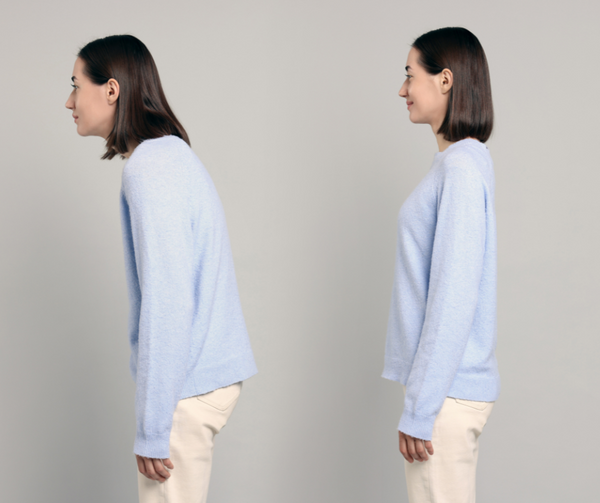
Fixing forward head posture means retraining your head to sit over your shoulders instead of in front of them. Daily chin tucks, upper-back strengthening, a screen at eye level and a pillow that supports your neck's curve are the standard approach, and the change comes from steady practice rather than one quick fix.
Key takeaways
- Forward head posture means your head sits in front of your shoulders, which adds load to your neck muscles.
- Screens, long hours sitting still and your sleep setup are the usual causes.
- Daily chin tucks, chest and upper-trap stretches and upper-back exercises, plus a screen at eye level, are the standard fix.
- Change comes from weeks of steady practice, not one quick fix.
What is forward head posture?
Forward head posture is when your head sits in front of your shoulders instead of stacked on top of them, which increases the load your neck muscles have to manage (NASM). You may also hear it called "tech neck" or "nerd neck".
A quick check
Ask someone to take a photo of you from the side while you stand normally. If your ear sits clearly in front of your shoulder, your head is drifting forward.
Common signs include a stiff neck, tight shoulders and tension at the base of your skull. Cleveland Clinic also lists headaches among the symptoms of tech neck (Cleveland Clinic); our guide on whether neck pain can cause headaches explains the link.
What causes it?
- Looking down at screens. Cleveland Clinic chiropractor Andrew Bang, DC, compares your head to a 10- to 12-pound bowling ball and says reading a phone near your lap can put upwards of 60 pounds of load on your neck (Cleveland Clinic). Read more in our guide to what tech neck is and how to ease it.
- Muscle imbalance. Muscles at the back and top of the neck and shoulders become overactive while the deep neck flexors at the front become underactive (NASM). It often comes with rounded shoulders.
- Staying still too long. The NHS advises not keeping your neck in the same position for a long time, for example at a desk (NHS).
- Your sleep setup. A pillow that is too high or stacked, or sleeping on your front, can hold your neck at an awkward angle for hours.
How to correct it: 5 exercises (chin tucks first)
A review of seven randomized trials (627 participants) found that therapeutic exercise produced large changes in the craniovertebral angle, a common measure of forward head posture, and moderate improvements in neck pain (Sheikhhoseini et al., 2018).
Before you start
Move slowly and stop if anything causes pain, numbness or tingling. If you've had a neck injury or surgery, check with your doctor or a physical therapist first.
1. Chin tucks
These train the deep neck flexors that help hold your head over your shoulders.
- Sit tall with your head in its normal position.
- Slowly glide your head straight back, tucking your chin in. Keep your head level; don't nod.
- Hold for 3 to 5 seconds, then release. Repeat 10 times.
Harvard Health suggests doing this daily at first, then a few times a week (Harvard Health).
2. Doorway chest stretch
- Place your forearm on a door frame, elbow at shoulder height and bent to about 90 degrees.
- Step forward gently until you feel a stretch across your chest.
- Hold for 20 to 30 seconds, then switch sides.
3. Upper trap stretch
- Sit tall and tilt your ear toward one shoulder without lifting that shoulder.
- Rest your hand lightly on your head if you want a little more stretch. Don't pull.
- Hold for 20 to 30 seconds per side.
4. Wall angels
- Stand with your back against a wall and raise your arms into a "goal post" shape.
- Slowly slide your arms up and down, keeping them as close to the wall as is comfortable.
- Repeat 8 to 10 times.
For more moves like this, see our stretches for upper back pain.
5. Prone Y raises
- Lie face down, arms overhead in a Y shape, thumbs up.
- Squeeze your shoulder blades down and back and lift your arms a few inches.
- Hold for 2 to 3 seconds, then lower. Repeat 8 to 10 times.
NASM's correction sequence combines this kind of shoulder-blade work with chest and upper-trap stretches and chin tucks, in about 8 to 12 minutes (NASM).
Desk and phone setup
- Raise your screen to eye level so you don't have to look down as much (Harvard Health). On a laptop, use a stand with a separate keyboard and mouse.
- Bring your phone up instead of looking down into your lap, and use headphones or a stand for long calls (Cleveland Clinic).
- Sit upright, rolling your shoulders back gently and bringing your neck back (NHS).
- Move often. Set a reminder every 20 to 30 minutes to stand up, roll your shoulders and do a few chin tucks.
Sleep support
The NHS recommends a low, firm pillow that keeps your head at the same height as the rest of your body, and not sleeping on your front (NHS). If you sleep on your back, choose a pillow that fills the curve of your neck without pushing your head forward. If you sleep on your side, it should fill the gap between your ear and shoulder. Our look at whether a pillow can get rid of a neck hump covers what support can and can't do.
If you'd like extra support at home, the Thera Pillow is a cervical pillow with three modes (air-powered traction at a 26° angle, heat and vibration massage). Use it alongside your exercises and sleep setup, not instead of them.

A cervical pillow with 3 modes: air-powered traction at a 26° angle, heat and vibration massage.
$251.00How long it takes
There is no fixed timeline. It depends on how long your head has been drifting forward, your screen time and how consistently you practice. Cleveland Clinic's Dr. Bang says it takes about four to six weeks of a consistent routine to see real change (Cleveland Clinic), and long-standing posture may take longer. A side-on photo every two weeks helps you see progress.
When to see a clinician
See a doctor if neck pain or stiffness doesn't go away after a few weeks, if painkillers haven't helped, or if you have pins and needles or a cold arm (NHS). Numbness or tingling into the arms and worsening headaches are also reasons to get checked (NASM).
FAQ
What is forward head posture?
Forward head posture is when your head sits in front of your shoulders instead of directly above them. From the side, your ear lines up in front of your shoulder rather than over it.
What causes forward head posture?
Forward head posture is usually caused by daily habits: looking down at screens, sitting still for long periods and a sleep setup that holds your neck at an angle. Over time, this leaves some neck muscles overworked and the deep neck flexors underused.
How do you correct forward head posture?
You correct forward head posture with daily chin tucks, chest and upper-trap stretches, upper-back strengthening, a screen at eye level and regular movement breaks. A 2024 review found that programs combining strength, stretching and shoulder exercises may be effective (Sepehri et al., 2024).
Is forward head posture permanent?
Forward head posture that comes from daily habits usually responds to exercise and better setup, though progress varies. If pain doesn't settle or you've had a neck injury, see a doctor or physical therapist.
Does sleeping without a pillow help forward head posture?
Sleeping without a pillow isn't usually the answer. For most people, a low, firm pillow that keeps the head level with the body is the better choice (NHS).
Sources
- NASM - "Forward Head Posture: A Trainer's Assessment and Correction Guide." https://www.nasm.org/resource-center/blog/recovery/fixing-forward-head-posture (accessed 28 Oct 2026)
- Cleveland Clinic Health Essentials - "Tech Neck: A Modern-Day Pain" (19 Nov 2025; expert: Andrew Bang, DC). https://health.clevelandclinic.org/tech-neck (accessed 28 Oct 2026)
- NHS - "Neck pain." https://www.nhs.uk/conditions/neck-pain/ (accessed 28 Oct 2026)
- Sheikhhoseini R, Shahrbanian S, Sayyadi P, O'Sullivan K. "Effectiveness of Therapeutic Exercise on Forward Head Posture: A Systematic Review and Meta-analysis." Journal of Manipulative and Physiological Therapeutics, 2018. PMID 30107937, doi:10.1016/j.jmpt.2018.02.002. https://europepmc.org/article/MED/30107937 (abstract, accessed 28 Oct 2026)
- Harvard Health Publishing - "Do habits cause your neck pain?" (1 Jun 2016). https://www.health.harvard.edu/pain/do-habits-cause-your-neck-pain (accessed 28 Oct 2026)
- Cleveland Clinic Health Essentials - "Poor Posture Hurts Your Health More Than You Realize: Tips for Fixing It" (6 Aug 2021; expert: Andrew Bang, DC). https://health.clevelandclinic.org/health-effects-of-poor-posture (accessed 28 Oct 2026)
- Sepehri S, Sheikhhoseini R, Piri H, Sayyadi P. "The effect of various therapeutic exercises on forward head posture, rounded shoulder, and hyperkyphosis among people with upper crossed syndrome: a systematic review and meta-analysis." BMC Musculoskeletal Disorders, 2024. PMID 38302926, doi:10.1186/s12891-024-07224-4. https://europepmc.org/article/MED/38302926 (abstract, accessed 28 Oct 2026)