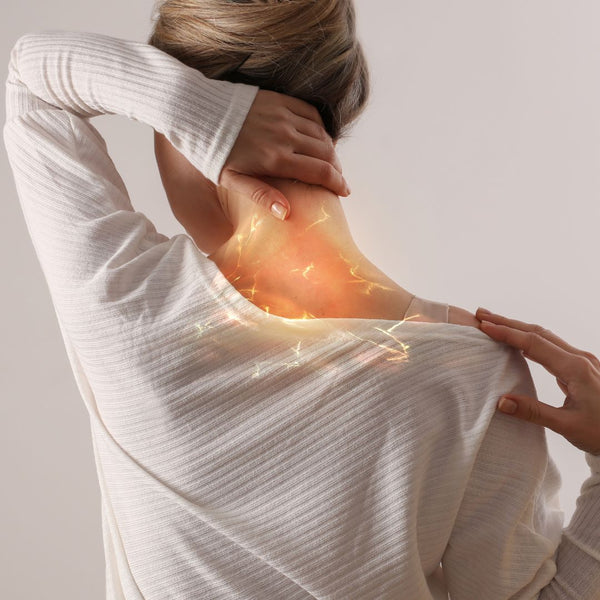
Neck pain relief at home usually starts with gentle movement, heat or cold, a supportive pillow and less time with your head pushed forward. Most everyday neck pain from strain or posture eases with these steps. Pain after an injury, or with numbness, weakness, fever or a severe headache, needs a doctor first.
Below: what to try today, the warning signs that mean you should get checked, and our detailed guides, sorted by problem.
Key takeaways
- Start with gentle movement, heat or cold, a supportive pillow and less time looking down.
- Cold usually suits a fresh strain; heat suits tight, achy muscles.
- Most everyday neck pain from strain or posture eases with these steps.
- Pain after an injury, or with numbness, weakness, fever or a severe headache, needs a doctor first.
What to try first
Most causes of neck pain improve and can be managed at home, according to Cleveland Clinic. If your pain came on after desk work, an awkward night's sleep or a stressful week, and you otherwise feel well, start here.
- Keep your neck moving gently. The NHS advises keeping it moving and not wearing a collar unless a doctor tells you to. NHS inform suggests moving it for short periods every hour and keeping up normal activities, even at a slower pace.
- Use heat or cold for short sessions. Both are standard home options; see the next section.
- Change what set it off. Long hours in one position, looking down at a screen and tensing up under stress are common causes.
- Check your pillow and sleep position. A pillow at the wrong height, or sleeping on your front, can strain your neck all night.
- Consider over-the-counter pain relief, if it suits you. Cleveland Clinic, MedlinePlus and the NHS mention ibuprofen or acetaminophen. Follow the label, and ask a pharmacist first if you take other medicines or have a health condition.
- Give it time, and watch for warning signs. Pain from strain or stress usually improves within a week or two. If any of the warning signs further down apply to you, get checked first.
If your neck locks up and won't turn, our guide to what causes a stiff neck and how to loosen it goes into more detail.
Heat or ice
Both can help. It mostly depends on whether your pain is new or has been around a while.
Ice for a fresh strain or injury. Cleveland Clinic says cold is usually the better choice for fresh injuries or new aches, because it helps numb pain and limit swelling, and advises cold instead of heat right after an injury. MedlinePlus suggests ice for the first 48 to 72 hours, then heat.
Heat for tight, achy muscles. Heat increases blood flow and helps tight muscles relax. Try a warm shower, a warm compress or a heating pad on its lowest setting.
How to do it safely
- Keep sessions short. Cleveland Clinic suggests about 15 minutes every few hours. The NHS suggests a wrapped bag of frozen peas for 5 minutes, 3 times a day, or a wrapped hot water bottle for 20 minutes, 2 to 3 times a day.
- Always use a barrier, such as a towel, and leave a few hours between sessions. Stop if your skin reddens or blisters.
- Never fall asleep with a heating pad or ice bag in place.
With a pulled muscle you may use both: cold first, then heat once stiffness sets in. If neither helps, contact a healthcare provider.
Stretches and movement
NHS inform describes four simple exercises for a new neck problem:
- Head turn. Slowly turn your head to one side as far as is comfortable, hold for 2 seconds, return, then repeat on the other side.
- Head tilt. Tilt your head toward one shoulder until you feel a stretch on the other side. Hold for 2 seconds, return, switch sides.
- Forward head tilt. Bring your chin down toward your chest, then slowly bring it back up.
- Wide shoulder stretch. Elbows bent at a right angle, palms up, move your forearms out to the sides while keeping your upper arms still. Hold for a few seconds, then bring them back.
How much to do. Start with 2 to 3 repetitions, little and often (for example, every hour), and build toward about 10 as it gets easier.
How much discomfort is OK. On a 0 to 10 scale, NHS inform suggests keeping pain at 5 or below while you exercise and easing off if it goes higher. Stop if an exercise makes your symptoms worse or causes new pain.
If posture is part of the problem, Mass General Brigham describes chin tucks (draw your chin straight back until your ears line up over your shoulders) and low rows (squeeze your shoulder blades down and back), each held for about 30 seconds.
Cleveland Clinic advises against neck exercises if you have a serious neck injury or a pinched nerve; check with your doctor or a physical therapist first. When the ache spreads across your shoulders and upper back, try these upper back stretches you can start today.
Your pillow and sleep position
- Keep your head level with your body. The NHS suggests your head should be the same height as the rest of your body when you sleep, with a low, firm pillow and a firm mattress.
- Get the pillow height right. If you sleep on your back, Cleveland Clinic says a pillow that's too low tips your jaw toward the ceiling, and one that's too high pushes your jaw toward your chest. If you sleep on your side, your pillow should be thick enough to support your head and neck without letting it droop.
- Don't stack pillows. Harvard Health warns that several pillows under your head can limit your neck's range of motion. Mass General Brigham suggests a curved pillow that fills the gap under your neck instead.
- Try not to sleep on your front. It keeps your head turned to one side for hours; the NHS and Cleveland Clinic both advise against it.
- Don't twist in bed. The NHS advises against it. When you turn over, move your head and shoulders together.
For a full checklist on height, firmness and shape, read our guide on how to choose a pillow for neck pain.
Some people also add a cervical traction pillow. The Callixe Thera Pillow has three modes (air traction that lifts at a 26° angle, heat, and vibration massage with 4 patterns), and it switches off automatically at 30-minute intervals. It's an optional extra for comfort, not a medical treatment, and it doesn't replace the steps on this page or your doctor's advice. It comes with a 90-night money-back guarantee. If you have a diagnosed neck condition, check with your doctor or physical therapist before using any traction device.

A cervical pillow with 3 modes: air-powered traction at a 26° angle, heat and vibration massage.
$139.00Posture and screens
Your head weighs roughly 10 to 12 pounds, and the load on your neck rises the further you tilt it forward. A few setup changes help.
- Raise your screen. Cleveland Clinic suggests positioning your monitor so your eyes land around the bottom of the top third of the screen. Harvard Health recommends a monitor at eye level.
- Use a separate keyboard and mouse with a laptop, so you can raise the screen without straining your arms.
- Bring your phone up, not your head down. Hold devices closer to eye level, prop a tablet at about 45° rather than flat on your lap, and use a headset or speaker instead of wedging the phone against your shoulder.
- Keep your glasses prescription up to date. An old one can make you tilt your head back to see.
- Move often. Dr. Bang suggests changing position at least every 20 minutes and keeping handheld screen sessions to 15 to 30 minutes. Standing up, stretching or walking every 45 to 60 minutes also helps.
For more on phones and laptops, our guide to tech neck and how to ease it has more ideas.
When neck pain needs a doctor
Most neck pain settles with home care, but these symptoms mean you should get help first rather than wait it out.
Call 911 or go to the emergency room if your neck pain comes with
- Fever, headache and a stiff neck, especially with sensitivity to light, nausea or vomiting, confusion, or if your neck is so stiff you can't touch your chin to your chest. This can be a sign of meningitis, which needs urgent treatment.
- Sudden weakness or numbness in an arm, shooting pain down an arm, or loss of balance.
- Loss of bladder or bowel control.
- Chest pain or pressure, shortness of breath, sweating, or arm or jaw pain, which can be signs of a heart problem.
- A serious injury, such as a car accident or fall, especially if you can't move your arm or hand.
See your doctor promptly if
- Your pain started after an accident, fall or blow, even if it seems mild.
- You have numbness, tingling or weakness in your arms, hands, shoulders or legs, or clumsy hands.
- The pain is severe, wakes you at night or gets worse when you lie down.
- It isn't improving: Cleveland Clinic and MedlinePlus suggest contacting a provider if it hasn't improved after one week of self-care, and the NHS says to see a GP if it hasn't gone away after a few weeks.
- You have unexplained weight loss, chills or a fever with your neck pain.
- Your neck pain starts while you have another condition such as cancer or rheumatoid arthritis, or you feel generally unwell.
- You have swollen glands or a lump in your neck, or trouble swallowing or breathing.
- Over-the-counter pain relief isn't helping, or you're simply worried.
To understand what these signs can mean, read how to tell if neck pain is a sign of something serious.
Guides by problem
- Stiff neck that won't turn: stiff neck causes and quick relief
- Tight neck and shoulders: shoulder and neck tension: causes and home solutions
- Pain from phones and laptops: what tech neck is and how to get rid of it
- Head pushed forward: how to fix forward head posture at home
- A hump at the base of the neck: does a pillow for a neck hump actually work?
- Rounded shoulders: how to sleep to improve rounded shoulders
- Upper back pain between the shoulders: simple stretches for upper back pain
- Choosing a pillow: what to look for in a pillow for neck pain
- Using a traction pillow: how to use a neck traction pillow, step by step
- Headaches with neck pain: can neck pain cause headaches?
- Worried it's serious: can neck pain be a sign of something serious?
FAQ
How do you relieve neck pain at home?
Keep your neck gently moving, use heat or cold for short sessions, sleep with your head level on a supportive pillow, and raise your screens. See a doctor if the pain is severe, follows an injury or isn't improving.
How do you get immediate relief from neck pain?
There's no instant fix, but you can take the edge off: a warm shower or wrapped heat pack (or cold, if the strain is fresh), a few slow head turns and tilts, and getting up from the position that set it off. Severe pain, or pain with fever, headache or arm weakness, needs urgent care instead.
How do you choose pillow height for neck pain relief?
Pick a height that keeps your head level with your body. On your back, too low tips your chin up and too high pushes it toward your chest; on your side, the pillow should stop your head drooping.
Is heat or ice better for neck pain?
Ice is usually better for a fresh strain or injury, and heat for tight, achy muscles. MedlinePlus suggests ice for the first 48 to 72 hours, then heat. Wrap either one and keep sessions short.
How long does neck pain take to go away?
Neck pain from strain or stress usually improves within a week or two, though it can take a few months to go completely. Contact a doctor if it hasn't improved after a week of self-care, or sooner with any warning signs.
This article is for general information and isn't a substitute for advice from your doctor or physical therapist. If you're unsure about your symptoms, get them checked.
Sources
- Cleveland Clinic, "Neck Pain" (Health Library, medically reviewed, last updated 9 Dec 2022). https://my.clevelandclinic.org/health/symptoms/21179-neck-pain (accessed 30 Oct 2026)
- Cleveland Clinic Health Essentials, "Ice vs. Heat: Which Is Better for Your Pain?" (5 Feb 2025; experts incl. Anne Rex, DO). https://health.clevelandclinic.org/should-you-use-ice-or-heat-for-pain-infographic (accessed 30 Oct 2026)
- NHS, "Neck pain" (page last reviewed 27 Apr 2023). https://www.nhs.uk/conditions/neck-pain/ (accessed 30 Oct 2026)
- MedlinePlus (U.S. National Library of Medicine), "Neck pain" (review date 14 Jan 2026). https://medlineplus.gov/ency/article/003025.htm (accessed 30 Oct 2026)
- NHS inform (NHS 24 MSK Clinical Advisory Group), "Neck problems" (last updated 28 Oct 2026). https://www.nhsinform.scot/illnesses-and-conditions/muscle-bone-and-joints/neck-and-back-problems-and-conditions/neck-problems (accessed 30 Oct 2026)
- NHS inform, "Exercises for neck problems" (modified 24 Jul 2026). https://www.nhsinform.scot/illnesses-and-conditions/muscle-bone-and-joints/neck-and-back-problems-and-conditions/exercises-for-neck-problems (accessed 30 Oct 2026)
- Mass General Brigham, "Stiff Neck Remedies" (expert: Zacharia Isaac, MD; page published 30 Jun 2026). https://www.massgeneralbrigham.org/en/health-wellness/stiff-neck-remedies (accessed 30 Oct 2026)
- Harvard Health Publishing, "6 ways to ease neck pain" (reviewed by Howard E. LeWine, MD, 12 Jan 2026). https://www.health.harvard.edu/pain/6-ways-to-ease-neck-pain (accessed 30 Oct 2026)
- Harvard Health Publishing, "When to seek immediate medical attention for neck pain" (31 Jan 2024). https://www.health.harvard.edu/pain/when-to-seek-immediate-medical-attention-for-neck-pain (accessed 30 Oct 2026)
- Cleveland Clinic Health Essentials, "Best Sleeping Positions for Pain" (26 May 2023; expert: Andrew Bang, DC). https://health.clevelandclinic.org/best-sleeping-positions-for-pain (accessed 30 Oct 2026)
- Cleveland Clinic Health Essentials, "Ergonomics 101: How To Set Up Your Desk To Avoid Aches and Pains" (21 Aug 2026; expert: Andrew Bang, DC). https://health.clevelandclinic.org/heres-how-to-set-up-your-office-to-avoid-aches-pain (accessed 30 Oct 2026)
- Cleveland Clinic Health Essentials, "Tech Neck: A Modern-Day Pain" (19 Nov 2025; expert: Andrew Bang, DC). https://health.clevelandclinic.org/tech-neck (accessed 30 Oct 2026)
- Cleveland Clinic, "Stiff Neck" (Health Library, medically reviewed, last updated 12 Mar 2026). https://my.clevelandclinic.org/health/symptoms/24477-stiff-neck (accessed 30 Oct 2026)